
Dual Touch Screen POS Security and PCI Compliance Essentials
A dual-display point-of-sale platform combines an operator-facing screen with a customer-facing display, creating a faster and more transparent checkout experience while introducing additional security considerations. A secure deployment must isolate payment functions, prevent unauthorized access to customer-facing interfaces, protect cardholder data throughout transmission, and provide evidence for PCI DSS assessments. Buyers should evaluate secure boot, operating-system hardening, role-based access, encrypted communications, tamper-resistant payment devices, network segmentation, software maintenance, and supplier documentation before selecting a POS system. The most reliable approach treats hardware, payment applications, peripherals, network controls, staff procedures, and incident response as one security architecture rather than as separate product features.
Security Architecture for Two-Screen Checkout Terminals
Separate the customer and cashier interaction zones
A dual-display checkout terminal creates two user environments with different trust levels. The cashier screen may expose pricing tools, refunds, discounts, inventory functions, and administrative controls, while the customer screen should normally provide limited functions such as item confirmation, loyalty prompts, tipping, digital receipt selection, language preferences, or payment instructions. These interfaces should run with clearly separated permissions. Customers must not be able to reach operating-system settings, transaction databases, browser utilities, diagnostic menus, or staff-only applications through the outward-facing display.
Procurement specifications should require kiosk-mode controls, locked-down user sessions, screen-content validation, and automatic restoration of the approved customer interface after every transaction. A POS supplier should also explain how the system handles touch events, display switching, remote support, and failure recovery. If a customer-facing screen can be repurposed as a general-purpose monitor, the risk of unauthorized browsing, malware installation, or exposure of internal information increases.
Protect the payment path from the POS application
The payment card data environment should be designed so that the checkout application receives as little sensitive information as possible. In a properly integrated architecture, the payment terminal handles card interaction and returns limited transaction results or tokens to the POS application. Full primary account numbers, magnetic-stripe data, and card verification values should not be stored in ordinary transaction logs, screenshots, databases, or support files.
Buyers should ask whether the payment device supports point-to-point encryption, tokenization, EMV chip transactions, contactless payments, and secure key management through the acquiring or payment-service provider. PCI DSS establishes technical and operational requirements for entities that store, process, or transmit payment account data. A validated payment solution can reduce exposure, but it does not automatically remove the merchant’s responsibilities. The payment application, network, access controls, policies, and service-provider relationships still require assessment.
Harden hardware, firmware, and connected peripherals
Security begins before software configuration. A commercial terminal should use controlled firmware, protected system ports, stable power, and a chassis that discourages unauthorized access to storage, cabling, or payment peripherals. USB ports that are not required for daily operation should be disabled, physically restricted, or monitored through endpoint policies. Booting from external media should be blocked, and administrative firmware settings should be protected by strong credentials.
Connected equipment deserves the same attention as the main terminal. A thermal printer may expose order information through unprotected network access, a cash drawer can create operational risk if triggered without authorization, and a price checker may become an unmanaged endpoint if it runs on the same network as payment devices. Handheld POS terminals, scanners, receipt printers, customer displays, and back-office workstations should be inventoried, assigned an owner, and included in patching and incident-response procedures.
PCI DSS Controls That Matter in Real Deployments
Scope, segmentation, and data-flow mapping
PCI compliance starts with an accurate data-flow diagram. The project team should document where payment begins, which device reads or accepts card information, how authorization messages travel, where tokens or receipts are retained, and which suppliers can access the environment. The diagram should include wireless networks, payment gateways, remote-management tools, store controllers, cloud services, and support connections.
Network segmentation can limit the systems connected to the cardholder data environment. Payment terminals should not share unrestricted network access with guest Wi-Fi, digital signage, employee devices, surveillance equipment, or general office computers. Firewalls, access-control lists, secure wireless configurations, and deny-by-default rules provide practical barriers. Segmentation must be tested rather than assumed; an auditor or qualified security professional may require evidence that prohibited communication paths are genuinely blocked.
Authentication, authorization, and audit trails
Every employee should use an individual account rather than a shared cashier credential. Permissions should follow job responsibilities, with separate rights for sales, voids, refunds, price changes, inventory, configuration, and system administration. Multi-factor authentication is especially important for remote administration, cloud dashboards, support portals, and privileged accounts.
Audit logs should record successful and failed logins, privilege changes, refunds, voids, configuration changes, payment integration events, and remote-support activity. Logs must be protected from unauthorized alteration and retained according to the organization’s policy and applicable requirements. A useful POS security design makes suspicious behavior visible without forcing managers to manually inspect every transaction. Alerts for repeated login failures, unusual refunds, disabled security controls, or unexpected device changes can shorten response time.
Vulnerability management and secure maintenance
PCI DSS requires organizations to maintain security processes, test defenses, manage vulnerabilities, and protect systems from malicious software. A POS buyer should therefore request a documented patch policy, supported operating-system lifecycle, vulnerability disclosure process, malware protection approach, and update rollback procedure. Updates should be tested against payment applications, printers, scanners, customer displays, and store-management integrations before broad deployment.
Remote service is useful for multi-site operations, but it must be controlled. Support access should be time-limited, approved by an authorized operator, encrypted, logged, and disabled when no longer required. Supplier contracts should define responsibilities for security patches, breach notification, credentials, backups, data deletion, and subcontractors. These contractual details are as important as the terminal’s processor, screen resolution, or enclosure design.
| Control area | Weak deployment pattern | Stronger deployment pattern | Buyer evidence to request |
|---|---|---|---|
| Customer display | General-purpose desktop access | Restricted application or kiosk mode | Configuration guide and acceptance-test results |
| Payment acceptance | Card data handled directly by broad POS functions | Validated payment terminal with encryption or tokenization | Payment-provider documentation and PCI responsibility matrix |
| Network design | Payment devices share unrestricted guest or office access | Segmented network with controlled inbound and outbound paths | Network diagram, firewall rules, and segmentation test evidence |
| Employee access | Shared credentials and unlimited permissions | Unique accounts, least privilege, and multi-factor authentication for administrators | Role matrix and access-review procedure |
| Maintenance | Unscheduled updates and open remote tools | Tested patches, approved support sessions, and activity logging | Patch calendar, support policy, and sample logs |
| Incident response | Informal troubleshooting without evidence preservation | Documented isolation, notification, recovery, and review process | Incident-response plan and training records |
The table represents a control-oriented procurement framework rather than a substitute for a formal assessment. PCI DSS validation requirements vary according to the merchant’s transaction volume, payment channels, acquiring-bank program, and applicable regional rules. The PCI Security Standards Council document library provides the current standards and supporting resources, while the acquiring bank or payment processor determines which validation documents apply to a particular merchant.
Procurement and Implementation Priorities for Multi-Site Operators
Evaluate security evidence before comparing specifications
Screen size, processor performance, and appearance are visible, but security maturity is often hidden. A buyer’s request for proposal should ask for a software bill of materials where available, supported operating-system versions, secure-update procedures, vulnerability-response contacts, penetration-test summaries, payment-integration options, and third-party certifications relevant to the proposed architecture. Claims such as “PCI-ready” should be clarified because a device feature, a validated payment application, and a merchant’s complete PCI DSS compliance are different concepts.
Manufacturers and solution providers should also disclose the boundaries of their responsibility. The merchant may remain responsible for user accounts, store networks, policies, physical security, staff training, and the configuration of connected services. A clear responsibility matrix avoids gaps between the terminal supplier, payment processor, managed-service provider, software vendor, and internal IT team.
Test the complete transaction workflow
Factory acceptance testing should cover sale, cancellation, refund, split payment, contactless payment, offline behavior, receipt printing, customer-display recovery, network interruption, power restoration, and cash-drawer control. Security testing should verify that a customer cannot escape the approved screen, a cashier cannot access prohibited administration tools, and a disconnected device does not expose stored payment information.
Store pilots should be conducted before a national or international rollout. Pilot results should measure transaction speed, screen readability, peripheral reliability, staff training time, support volume, and recovery from common faults. For hospitality environments, the test should include table-service workflows, gratuity prompts, kitchen printing, handheld ordering, and intermittent wireless coverage. For supermarkets and retail stores, testing should include price lookup, barcode scanning, loyalty identification, returns, age-restricted products, and queue management.
Use recognized security guidance to strengthen governance
Security governance benefits from a broader risk-management framework. The NIST Cybersecurity Framework organizes activities around identifying, protecting, detecting, responding, and recovering from cybersecurity risks. Its principles can help POS operators establish asset inventories, assess supplier risk, monitor events, and improve incident procedures even when PCI DSS is the primary compliance obligation.
For information-security management, ISO/IEC 27001 provides a formal framework for establishing and continually improving an information security management system. It does not replace PCI DSS, but it can support disciplined governance across stores, warehouses, corporate offices, and technology suppliers. Contactless and chip-payment implementation should also be reviewed with the acquiring bank and relevant payment stakeholders rather than assumed from a hardware specification alone.
How FAVORPOS Supports Secure POS Projects
Integrated hardware for retail, catering, and supermarkets
FAVORPOS develops advanced POS systems and solutions for businesses using high-tech devices to improve operational performance. Our portfolio includes POS systems and peripherals, cash registers, handheld terminals and scanners, price checkers, thermal printers, cash drawers, and related accessories for retail, catering, supermarkets, and other market segments. This breadth helps project owners standardize hardware across checkout counters, service areas, mobile selling points, and back-office operations.
Our product discussions are structured around the complete workflow rather than a single terminal. A project may combine a fixed touchscreen station with a customer-facing display, a Handheld POS for line-busting or table service, a Price Checker for self-service information access, a Thermal Printer for dependable receipts, and a Cash Drawer with controlled opening logic. The final configuration should be matched to the merchant’s payment provider, software platform, network design, and compliance responsibilities.
OEM and ODM capability for controlled deployments
FAVORPOS provides OEM and ODM services to meet customer requirements across different markets and deployment models. Customization may involve enclosure design, branding, display configuration, peripheral compatibility, mounting arrangements, operating-system images, packaging, language support, and integration requirements. For distributors and enterprise project owners, controlled customization can simplify fleet management and create a consistent user experience across locations.
Our engineering and manufacturing processes emphasize product quality, long-term reliability, and practical serviceability. Buyers should still define security acceptance criteria in the project contract, including administrative-access controls, approved firmware, device inventory, update procedures, payment-terminal compatibility, and documentation delivered at shipment. This creates a measurable bridge between manufacturing quality and operational compliance.
Build a documented security partnership
FAVORPOS maintains a long-term commitment to quality and industry development, with the objective of supporting businesses in a competitive operating environment. Our team can help buyers evaluate POS system configurations, peripherals, deployment scale, and sector-specific workflows. Security and PCI DSS validation remain shared responsibilities involving the merchant, payment processor, software provider, network team, and relevant assessors, so implementation planning should identify every party before purchase orders are finalized.
For investors, brand owners, and distributors, the commercial value of a well-designed checkout platform extends beyond transaction acceptance. Reliable hardware can reduce downtime, improve staff productivity, support consistent customer interactions, and simplify expansion across locations. FAVORPOS aims to become a leading global manufacturer of point-of-sale systems and solutions by combining product development, OEM and ODM support, and customer-focused implementation planning.
Frequently Asked Questions
Does a dual-display POS system automatically meet PCI DSS requirements?
No. A dual-display terminal may support secure payment architecture, but PCI DSS compliance also depends on the payment application, network configuration, access controls, policies, monitoring, service providers, and merchant procedures.
Should the customer-facing screen have access to the operating system?
Normally, no. The customer display should use a restricted application or kiosk mode that prevents access to operating-system settings, staff tools, databases, browsers, and administrative functions.
Can tokenization or point-to-point encryption remove all PCI DSS responsibilities?
No. These technologies can reduce payment-data exposure and may reduce assessment scope, but merchants still retain responsibilities defined by their payment processor, acquiring bank, applicable PCI DSS requirements, and actual system configuration.
How should payment devices be connected to the POS network?
Payment devices should be inventoried and placed within a controlled network architecture separated from guest Wi-Fi, office computers, surveillance equipment, and other unnecessary endpoints. Firewalls, access rules, secure wireless settings, and segmentation testing should support the design.
What security documents should a POS buyer request from a supplier?
Buyers should request supported operating-system information, patch and vulnerability-management policies, payment-integration documentation, remote-support controls, security configuration guidance, product certifications where applicable, and a responsibility matrix describing supplier and merchant obligations.
Which peripherals should be included in a POS security review?
The review should include handheld terminals, scanners, price checkers, thermal printers, cash drawers, customer displays, back-office computers, wireless access points, and remote-management tools because each connected component can affect availability, access control, or data protection.
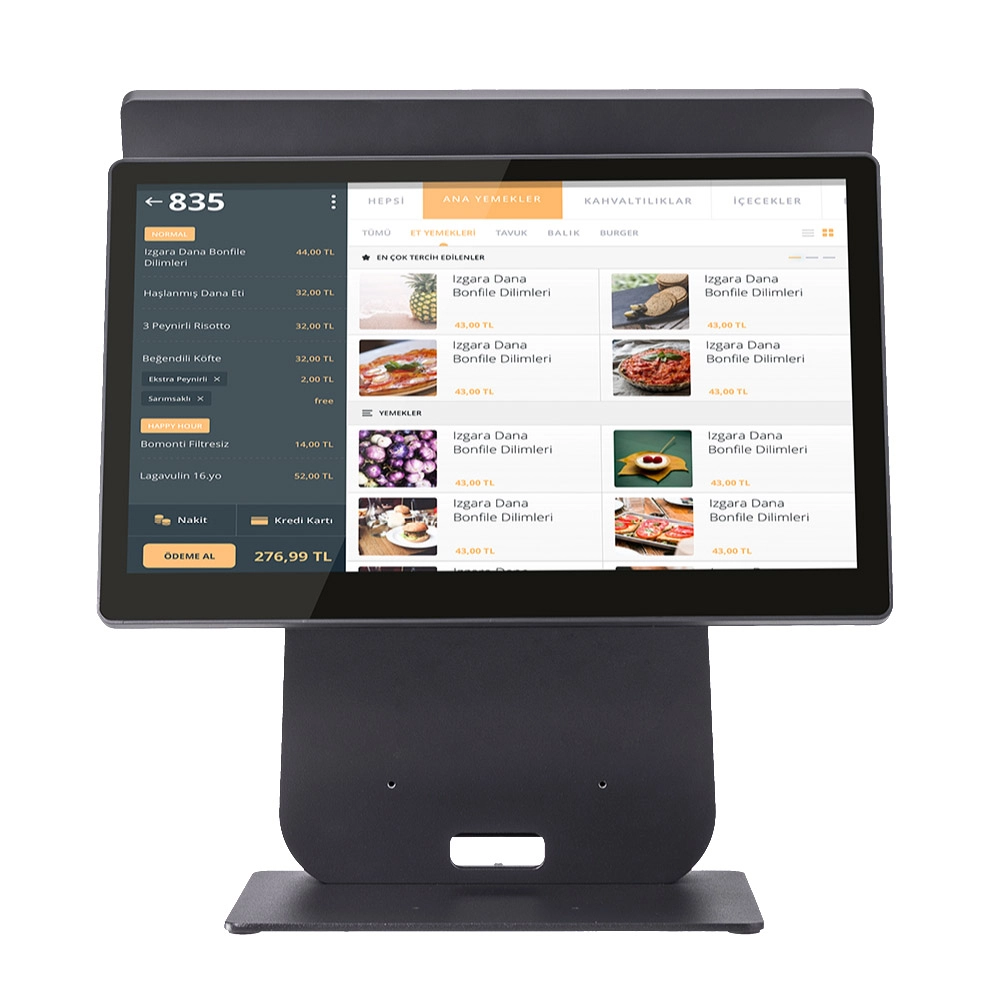
This dual-screen POS machine supports both Android and Windows systems, providing flexibility for various applications. The dual screens enhance customer interaction and streamline the checkout process, making transactions quicker and more engaging. Perfect for modern businesses looking to elevate their service and improve customer satisfaction, this POS machine is your ultimate partner in success!
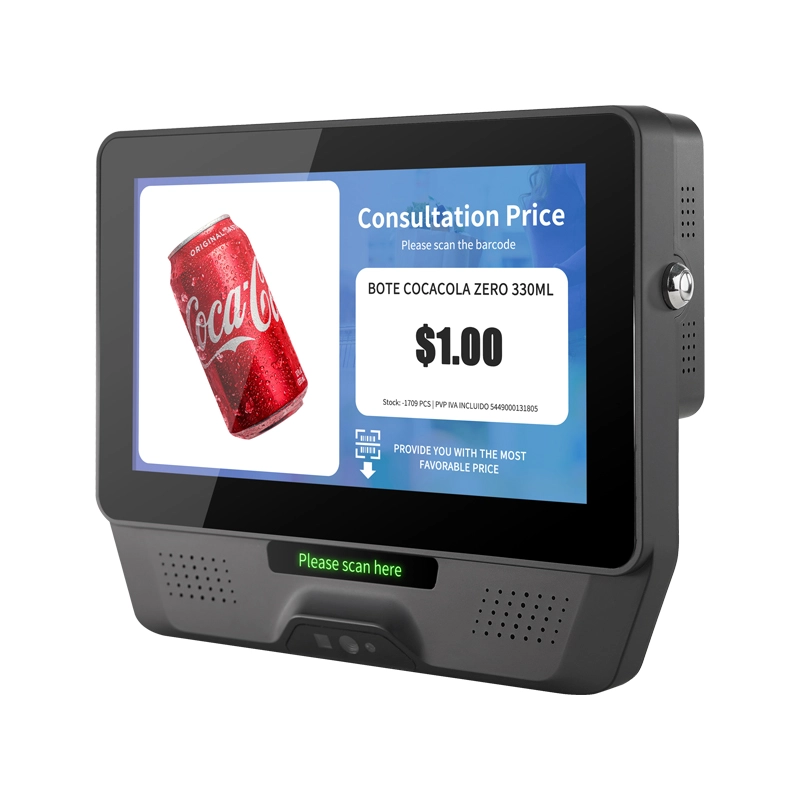
FAVORPOS 7 inch screen plastic price checker and custom check-in barcode scanner combines lightweight portability with reliable performance for retail and warehouse operations. Fast scanning, clear display, built to handle daily checkout demands.

FAVORPOS dual screen POS terminals deliver fast, reliable checkout performance for retail and hospitality businesses. Built by our commercial pos terminal manufacturer, these thin-profile systems streamline transactions while maximizing counter space—trusted by checkout pos systems factory operations worldwide.
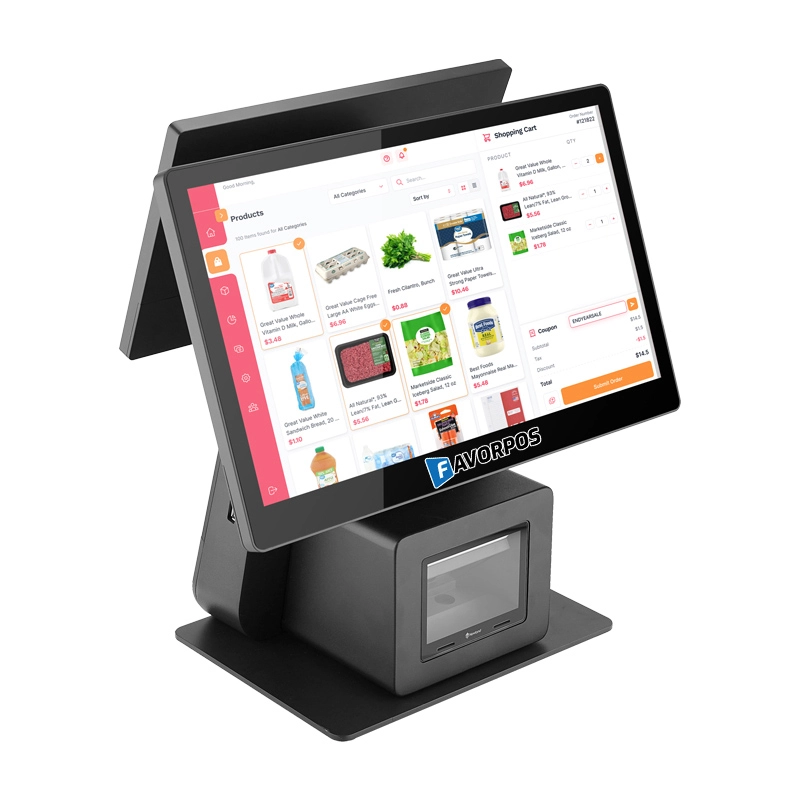
FAVORPOS: Your leading dual screen POS factory and manufacturer. Our desktop POS with barcode scanner offers 15.6/11.6 client screen options and OS flexibility. Get reliable, efficient dual screen POS with barcode scanner solutions directly from us.


Copyright © 2025 Favorpos All Rights Reserved.
