
Future Trends: AI, Voice and Gesture in POS Touch Screens
- How intelligent front-end displays are transforming checkout operations
- Voice-first and gesture-enabled checkout: technical and compliance considerations
- Procurement, deployment and lifecycle management for advanced interactive terminals
- Business impact: measurable outcomes and comparative analysis
- FAVORPOS: integrating advanced interfaces into enterprise-grade checkout ecosystems
- Frequently Asked Questions
The convergence of embedded machine intelligence, natural language interfaces, and contactless motion control is reshaping cashier and self-checkout displays; enterprise buyers evaluating a next-generation retail workstation or touchscreen checkout should prioritize modular hardware, edge AI inference, speaker/microphone arrays with far-field voice capture, and capacitive/proximity sensing capable of reliable gesture detection while meeting PCI and data protection requirements.
How intelligent front-end displays are transforming checkout operations
Edge AI for faster, privacy-preserving interactions
Edge inferencing moves machine learning workloads from cloud-only backends to local compute within the terminal, reducing latency for image recognition, predictive input and contextual UI adjustments. For operators, this translates to faster barcode-to-action cycles, reduced network dependency at peak hours, and improved privacy posture because sensitive biometric or transaction data can be processed on-device rather than transmitted. Buyers should request benchmarking data for model latency and quantized model sizes during procurement to validate on-device performance.
Multimodal interfaces: blending speech, touch and motion
Modern checkout consoles are evolving from single-input touch panels into multimodal hubs that accept spoken commands, touch gestures and hand motions. This hybrid interaction reduces friction for high-throughput environments: voice or gesture can accelerate common tasks (e.g., voids, item lookups, or loyalty redemption) while the touchscreen remains the primary confirmation surface. Integrations must include noise-cancelling microphone arrays and gesture sensors calibrated for diverse lighting and user heights.
Operational analytics and adaptive UI
Machine learning can analyze interaction patterns to optimize screen layouts and recommend shortcuts for frequently used functions. Retail IT teams should require systems that export anonymized event streams compatible with analytics platforms and support A/B UI testing, enabling iterative UX improvements without hardware replacements.
Voice-first and gesture-enabled checkout: technical and compliance considerations
Accuracy, language support and latency requirements
Voice interfaces must achieve enterprise-grade speech recognition across accents and languages in noisy retail or F&B environments. Buyers should specify word error rate (WER) targets, supported language packs, and acceptable end-to-end latency thresholds for command recognition. For mission-critical workflows, hybrid architectures that confirm voice actions on-screen before execution reduce downstream errors.
Gesture detection: sensor selection and environmental robustness
Gesture systems rely on a mix of time-of-flight sensors, infrared proximity arrays, and camera-based skeletal tracking. Procurement teams must validate sensitivity and false-positive rates under store lighting, crowding, and with users wearing gloves. Where privacy is a concern, prefer depth-only sensors or on-device skeletal extraction that avoids storing raw video frames.
Standards, certification and security posture
Compliance with payment and data protection standards is non-negotiable. Solutions should comply with PCI PIN Transaction Security (PTS) and follow guidance from standards bodies; consult Point of Sale (Wikipedia) for contextual industry definitions and ISO ergonomics standards for interface design considerations. Security controls for voice and gesture-enabled systems should align with best practices from NIST, and voice application accessibility and markup expectations should follow W3C recommendations where applicable.
Procurement, deployment and lifecycle management for advanced interactive terminals
Vendor evaluation: modularity, OEM/ODM options and TCO
Enterprise buyers must evaluate vendors on hardware modularity, availability of OEM/ODM customization, and total cost of ownership (TCO) across a typical five-to-seven year lifecycle. Key questions include how easily sensors or compute modules can be upgraded, whether firmware updates are signed and remotely deployable, and what warranty and spare-part logistics are provided for high-availability outlets.
Integration with POS backends and peripherals
New interactive displays must integrate reliably with existing payment gateways, receipt printers, cash draws and handheld terminals. Confirm compatibility matrices for peripheral interfaces (USB-C, RJ11 for cash drawers, serial for legacy printers), and validate middleware options that translate voice/gesture events into the POS workflow. Demand sandbox access to test integration with thermal printers, price-check scanners and handheld POS devices.
Change management and training for staff
Introducing multimodal terminals requires a structured rollout plan: pilot deployments, operator training, fallback procedures and clear KPI measurement (transaction time, error rate, customer satisfaction). Training content should include voice command best practices and gesture conventions to minimize accidental triggers and ensure consistent user behavior.
Business impact: measurable outcomes and comparative analysis
Operational KPIs influenced by intelligent interfaces
Primary KPIs include average transaction duration, queue throughput, cashier error rate and self-checkout abandonment. Interactions that switch to voice-first or gesture-assisted flows can reduce keystrokes-per-transaction and accelerate routine operations, but must be measured against increased support tickets and initial training costs.
Risk mitigation and privacy trade-offs
Deployers must weigh convenience gains against biometric privacy concerns. Implement opt-in models for biometric or voice profile storage, encrypt audio buffers at rest and in transit, and provide transparent disclosure to consumers where voice assistants or gesture logs are retained for analytics.
Comparative table: legacy checkout vs AI-driven multimodal terminals vs voice/gesture-optimized stations
| Feature | Legacy touchscreen + barcode | AI-augmented touchscreen (edge ML) | Voice/Gesture-optimized station |
|---|---|---|---|
| Primary input | Capacitive touch, physical keypad | Touch with on-device inference for suggestions | Voice + gesture + touch hybrid |
| Average transaction latency | Deterministic; network dependent for lookups | Lower latency for ML tasks due to edge processing | Low for local commands; voice performance varies with noise |
| Privacy footprint | Low (transactional data only) | Moderate (anonymized analytics on-device/cloud) | Higher if raw audio/video is transmitted; mitigated by local processing |
| Integration complexity | Low to medium | Medium (requires ML ops and model updates) | High (requires voice ASR, dialog management, sensor tuning) |
| Accessibility | Good for standard users | Improved via adaptive UI | Best for hands-free or mobility-limited users |
Table data reflects comparative functional attributes commonly used in vendor RFPs and aligns with operational guidance from standards and industry literature.
FAVORPOS: integrating advanced interfaces into enterprise-grade checkout ecosystems
Our approach to modular hardware and OEM/ODM flexibility
FAVORPOS supplies modular terminals and peripheral ecosystems tailored for multi-site rollouts. We offer customization through OEM and ODM channels to fit specific sensor suites, compute footprints and mounting configurations. Procurement teams benefit from standardized module swaps for faster field repairs and predictable lifecycle replacement plans.
Product portfolio aligned with multimodal deployments
Our catalog includes handheld point-of-sale devices, full-service checkout workstations, price-verification units and thermal printing solutions. For deployments requiring voice or gesture augmentation, our engineering team provides compatible sensor integrations and pre-validated drivers for popular payment and inventory management platforms. The product mix—handheld POS, retail-grade checkout terminals, Price Checker units, Thermal Printers and Cash Drawers—enables cohesive hardware ecosystems that minimize integration overhead.
Security, warranty and global support
FAVORPOS emphasizes compliance with payment security frameworks, secure firmware update mechanisms and remote device management. Our global logistics and warranty programs are structured to support rapid spare-part dispatch and on-site technical assistance, helping enterprise operators maintain high availability across retail and hospitality environments.
Deployment services and ROI focus
We provide end-to-end support from specification workshops to pilot validation and phased rollouts. Our teams model expected ROI by quantifying time-savings per transaction, projected reduction in errors, and potential improvements in basket size through contextual upsell prompts driven by on-device analytics.
For implementation nuance, vendors and buyers should cross-check UI ergonomics against ergonomics and human-computer interaction guidance from ISO ergonomics standards and adopt security recommendations from NIST to align privacy and resilience strategies.
Organizations planning to pilot voice or gesture-enabled checkout terminals should request developer kits, sample datasets and performance SLAs. FAVORPOS offers customizable proof-of-concept units and integration support to validate real-world performance before scale deployments.
Contact and product pages with specifications for handheld terminals, checkout workstations, price checkers, thermal printers and cash drawer solutions are available via the corporate site for procurement teams preparing RFPs and pilot programs.
Frequently Asked Questions
How does edge AI improve performance on modern checkout displays?
Edge AI reduces latency by running inference on-device, allowing image recognition and predictive suggestions to execute without constant cloud round-trips; this improves responsiveness during peak hours and mitigates intermittent network issues while preserving privacy by limiting transmitted data.
What should buyers verify when evaluating voice-enabled checkout terminals?
Buyers should verify speech recognition accuracy across required languages and accents, noise-robust microphone arrays, end-to-end latency metrics, support for on-device or hybrid ASR architectures, and clear opt-in consent and data retention policies to meet privacy obligations.
Are gesture interfaces reliable in busy retail environments?
Gesture systems can be reliable when using suitable depth sensors or time-of-flight modules and when calibrated for store lighting, occlusion and user height variance; procurement should request false-positive/negative rates and field trial data to validate real-world performance.
What integration checks are necessary for deploying multimodal terminals with existing peripherals?
Confirm supported peripheral interfaces (e.g., USB-C, RJ11, serial), compatibility with existing receipt printers, cash drawers and handheld scanners, availability of middleware or SDKs for event translation, and capabilities for remote firmware updates and device management.
How does FAVORPOS support enterprise rollouts of advanced interactive terminals?
FAVORPOS provides modular hardware, OEM and ODM customization, global warranty and spare-part logistics, integration support for payment and inventory systems, and pilot services to model ROI and validate performance with handheld POS devices, price checkers, thermal printers and cash drawers.
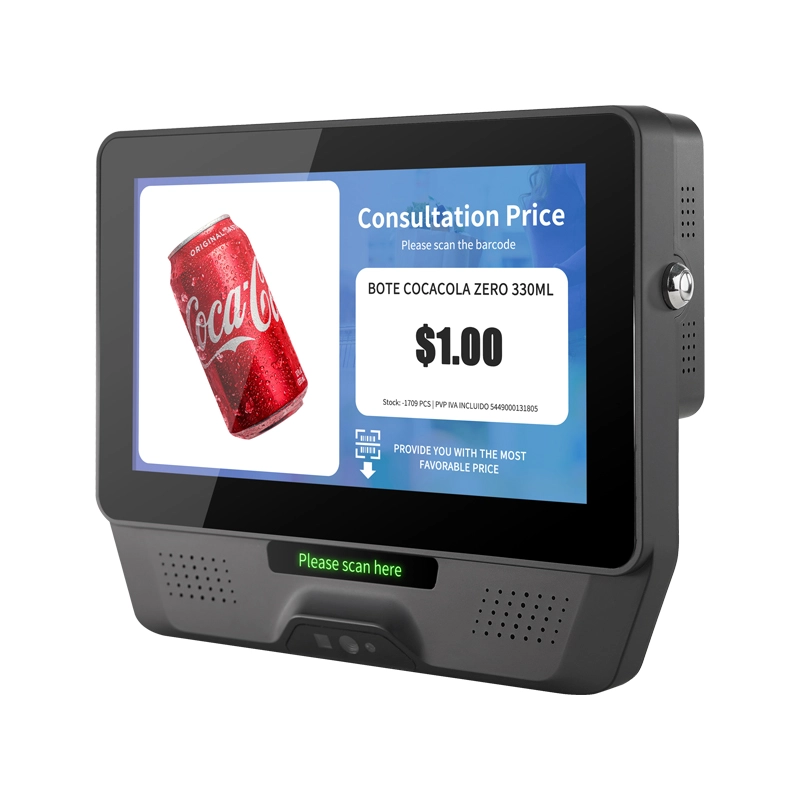
FAVORPOS 7 inch screen plastic price checker and custom check-in barcode scanner combines lightweight portability with reliable performance for retail and warehouse operations. Fast scanning, clear display, built to handle daily checkout demands.
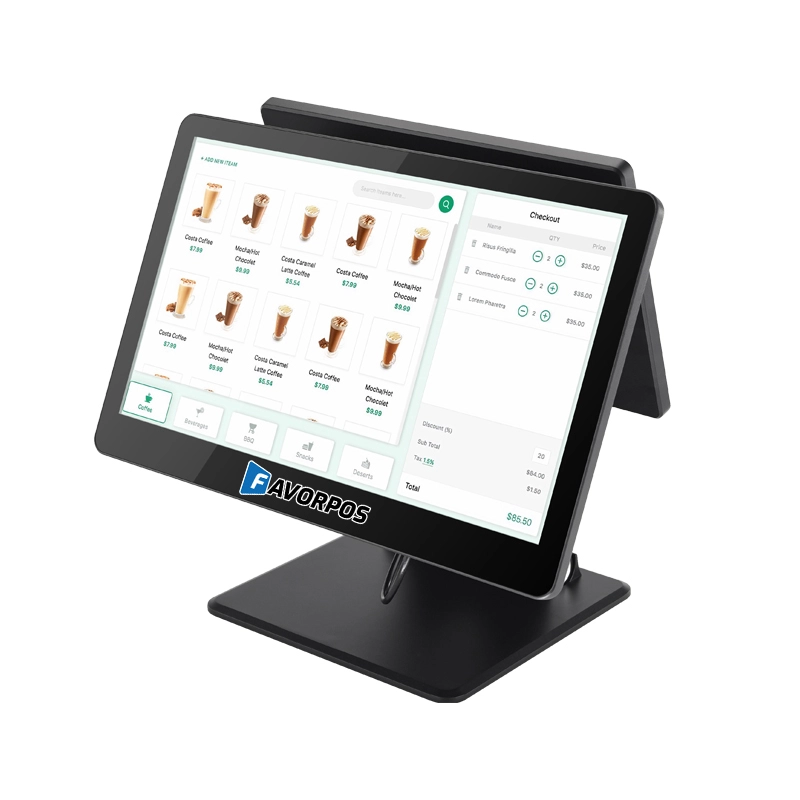
FAVORPOS dual screen POS terminals deliver fast, reliable checkout performance for retail and hospitality businesses. Built by our commercial pos terminal manufacturer, these thin-profile systems streamline transactions while maximizing counter space—trusted by checkout pos systems factory operations worldwide.
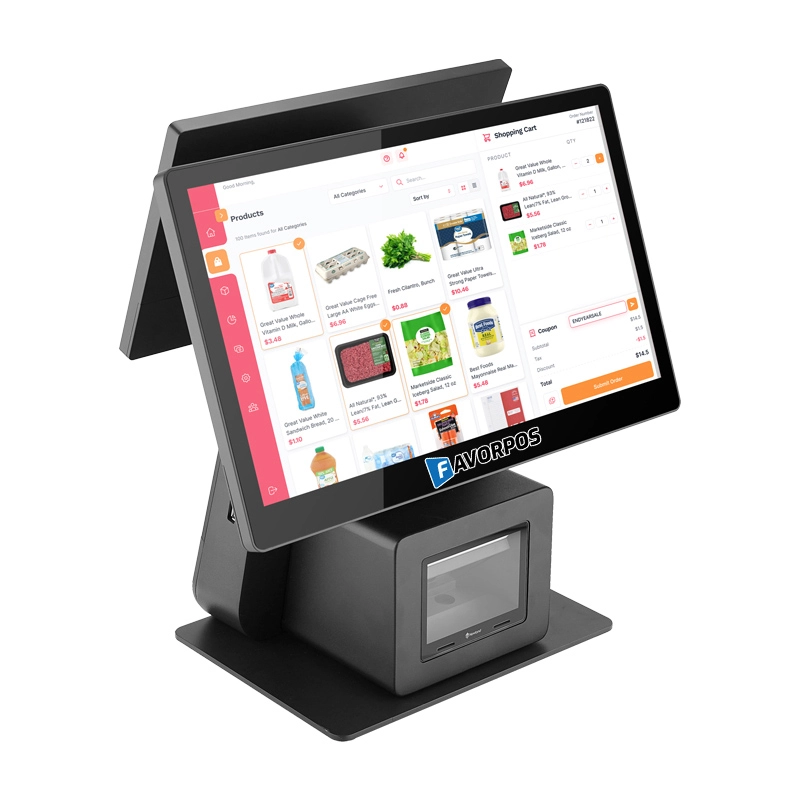
FAVORPOS: Your leading dual screen POS factory and manufacturer. Our desktop POS with barcode scanner offers 15.6/11.6 client screen options and OS flexibility. Get reliable, efficient dual screen POS with barcode scanner solutions directly from us.

FAVORPOS 11.6-inch capacitive touchscreen, specifically designed for POS machines to deliver a seamless and responsive user experience. This high-definition display offers vibrant visuals and crystal clear clarity, making it easy for staff to navigate through transactions efficiently. The capacitive technology ensures quick and accurate touch recognition, reducing wait times and enhancing customer satisfaction. Built to withstand the rigors of daily use, this touchscreen is perfect for retail and hospitality environments.


Copyright © 2025 Favorpos All Rights Reserved.
