
Cloud vs On-Premise POS: Which Is Best for Restaurants?
- The Evolving Landscape of Restaurant Technology
- Why a Robust POS System is Non-Negotiable
- Understanding the Core Components of Modern POS
- Unpacking On-Premise POS Systems: The Traditional Approach
- Advantages of On-Premise for Restaurateurs
- Drawbacks and Considerations for On-Premise
- When On-Premise Might Still Be Your Best Bet
- Embracing Cloud-Based POS: The Future-Forward Solution
- The Unmatched Flexibility and Accessibility of Cloud POS
- Navigating the Challenges of Cloud Deployment
- Ideal Scenarios for Cloud-Native Operations
- Making the Informed Choice: A Comparative Analysis
- Key Factors Influencing Your Decision
- The Long-Term Impact on Your Restaurant's Bottom Line
- Frequently Asked Questions (FAQ)
- Q1: How much does a good restaurant POS system cost?
- Q2: Can I use a cloud POS system without an internet connection?
- Q3: What are the essential features to look for in a restaurant POS system?
- Q4: Is a cloud POS system more secure than an on-premise system?
- Q5: How long does it take to implement a new POS system?
- Q6: Can a single POS system handle multiple restaurant locations?
As a professional deeply immersed in the intersection of SEO, , and the dynamic world of POS systems, especially within the bustling restaurant industry, I’ve witnessed firsthand how technology shapes success. The decision between a cloud-based and an on-premise Point of Sale (POS) system isn't just a technical one; it's a strategic business choice that profoundly impacts operational efficiency, customer experience, and ly, your bottom line. For restaurateurs, understanding which type of system aligns best with their unique needs – from a cozy café to a multi-location fine dining establishment – is paramount. This guide aims to demystify the options, providing you with actionable insights to select among the top restaurant POS systems available today.
Whether you're a startup looking for agile solutions or an established enterprise seeking to upgrade, the core question remains: Cloud or On-Premise? My experience tells me that there's no “one-size-fits-all” answer, but rather a “best fit” that depends on your specific operational demands, budget, technical capabilities, and long-term vision. Let’s dive deep into this critical comparison, ensuring your restaurant thrives with the right technological backbone.
The Evolving Landscape of Restaurant Technology
The restaurant industry is in constant flux, driven by shifting consumer expectations, technological advancements, and economic pressures. What was cutting-edge a decade ago is now standard, and what’s standard today will soon be surpassed. As I consult with businesses across various market segments, I emphasize that a restaurant's technology stack – particularly its POS system – is no longer just a transaction processor; it's the central nervous system connecting every aspect of the business.
Why a Robust POS System is Non-Negotiable
In today's competitive environment, a robust POS system is far more than a glorified cash register. It’s an integrated platform that orchestrates everything from order taking and payment processing to inventory management, staff scheduling, customer relationship management (CRM), and sales reporting. For many of my clients, selecting among the best restaurant POS software solutions has been a game-changer, enabling them to reduce errors, speed up service, optimize stock levels, and gain invaluable insights into their operations. A well-chosen POS system empowers restaurants to streamline workflows, enhance customer satisfaction through faster service and personalized experiences, and make data-driven decisions that boost profitability. Without a modern, efficient system, restaurants risk falling behind competitors, struggling with operational inefficiencies, and failing to meet the increasingly digital expectations of their patrons.
Understanding the Core Components of Modern POS
Modern POS systems, regardless of whether they are cloud-based or on-premise, typically consist of several core components. These include hardware such as touch screen terminals, receipt printers, cash drawers, and card readers. On the software side, capabilities often span sales and transaction processing, inventory management, employee management (time tracking, permissions), reporting and analytics, and increasingly, integration with online ordering platforms, delivery services, and loyalty programs. The sophistication and connectivity of these components determine the system's overall effectiveness. For instance, a system with excellent inventory tracking can significantly reduce waste, while robust reporting can identify peak hours and best-selling items, informing menu adjustments and staffing strategies. Recognizing these core components helps restaurateurs evaluate potential POS solutions for fine dining or casual eateries, ensuring they cover all essential operational bases.
Unpacking On-Premise POS Systems: The Traditional Approach
For decades, on-premise POS systems were the standard – and for good reason. They represented a significant investment in physical infrastructure and offered a degree of control that many restaurateurs valued. These systems, where software and data are hosted locally on your restaurant's own servers and computers, still hold appeal for certain types of operations.
Advantages of On-Premise for Restaurateurs
One of the primary advantages of an on-premise POS system is the high degree of control it offers. Since the software and data reside on your local servers, you have full ownership and direct access, potentially leading to enhanced security – provided you have robust in-house IT expertise. Data is stored on-site, which can be a comfort for businesses with strict data privacy policies or those operating in areas with unreliable internet connectivity. Furthermore, for restaurants with very specific or highly customized operational workflows, on-premise systems can often be tailored more extensively than their cloud counterparts. There are typically no recurring monthly subscription fees – you pay a larger upfront cost for the software and hardware, which some businesses prefer as a capital expenditure. This can make them an appealing option for established restaurants that value long-term stability and direct control over their infrastructure, often seen as some of the more reliable restaurant POS systems for local operations.
Drawbacks and Considerations for On-Premise
However, the advantages of on-premise come with significant drawbacks. The initial investment is often substantially higher, encompassing hardware, software licenses, server infrastructure, and installation costs. Moreover, managing an on-premise system demands dedicated IT staff or a reliable third-party IT support contract. This includes regular maintenance, software updates, data backups, and cybersecurity measures, all of which add to operational overhead. Scalability can also be a challenge; expanding your system to new locations or adding more terminals requires additional hardware purchases and IT configuration. In an era where data access from anywhere is increasingly important, on-premise systems restrict data access to the physical location, limiting remote management capabilities. This can be a significant hurdle for owners managing multiple establishments or needing to check reports from home. According to a 2022 IBM study, on-premise infrastructure often incurs higher operational costs over its lifespan due to maintenance and management.
When On-Premise Might Still Be Your Best Bet
Despite the rise of cloud solutions, on-premise POS systems can still be the best choice for specific restaurant profiles. These include large, established fine dining restaurants or multi-location enterprises that already have significant IT infrastructure and staff in place, and where a substantial upfront investment is less of a deterrent than ongoing subscription fees. Restaurants operating in areas with consistently poor or non-existent internet access might also find on-premise systems more reliable for uninterrupted service. Furthermore, businesses with highly proprietary data or unique compliance requirements that necessitate absolute control over data storage and security might lean towards an on-premise solution. While less common for new ventures, for specific legacy operations, these remain among the viable POS systems for small restaurants with very specific, local needs.
Embracing Cloud-Based POS: The Future-Forward Solution
Cloud-based POS systems represent a significant paradigm shift, leveraging internet connectivity to host software and data on remote servers managed by the POS vendor. This model has rapidly gained traction across industries, and the restaurant sector is no exception, with many of the top restaurant POS systems now predominantly cloud-native.
The Unmatched Flexibility and Accessibility of Cloud POS
The allure of cloud POS lies primarily in its unparalleled flexibility and accessibility. With a cloud system, you can access your data and manage your operations from anywhere, at any time, using any internet-enabled device. This means restaurant owners can monitor sales, check inventory, and manage staff schedules from home, on the go, or from another location – a critical advantage for multi-unit operators or those who travel frequently. Updates and maintenance are handled by the vendor, eliminating the need for in-house IT expertise and reducing operational burden. Cloud systems are typically subscription-based, offering a lower upfront cost and predictable monthly expenses, which can be highly attractive for startups and small to medium-sized businesses. Scalability is effortless; adding new terminals, locations, or features often involves just a few clicks or a call to customer support. Moreover, cloud solutions often integrate seamlessly with a wider ecosystem of third-party apps – from accounting software to online ordering platforms – creating a truly interconnected business environment. Many consider these to be the best mobile POS for restaurants due to their inherent mobility and remote capabilities.
Navigating the Challenges of Cloud Deployment
While cloud POS offers numerous benefits, it's not without its challenges. The most significant consideration is internet dependency. A stable and reliable internet connection is crucial for continuous operation. While most systems offer an "offline mode" that allows basic transactions to continue during outages, full functionality and data synchronization require connectivity. Data security, though managed by the vendor, remains a concern for some businesses. It's vital to choose a reputable provider with robust security protocols and clear data privacy policies, as your sensitive business and customer data resides off-site. Additionally, while customization options are growing, cloud systems may offer less deep customization compared to a fully tailored on-premise solution. Finally, over time, the cumulative monthly subscription fees can potentially surpass the upfront cost of an on-premise system, making long-term cost analysis essential.
Ideal Scenarios for Cloud-Native Operations
Cloud-based POS systems are ideally suited for a vast majority of modern restaurants. This includes new restaurants and startups looking for cost-effective, easy-to-deploy solutions; growing businesses planning to open multiple locations; and establishments that rely heavily on online ordering, delivery services, and customer loyalty programs. Restaurants with limited IT resources or those that value remote management and real-time data access will find cloud solutions particularly beneficial. For cafes, food trucks, pop-up restaurants, and quick-service establishments, the flexibility and mobility of cloud POS systems, especially those offering handheld POS devices, are transformative. They enable staff to take orders tableside, process payments anywhere, and reduce wait times, significantly enhancing the customer experience. This versatility makes them the go-to choice for those seeking agile and future-proof restaurant management systems.
Making the Informed Choice: A Comparative Analysis
To help you solidify your decision, let's look at a direct comparison of cloud and on-premise POS systems, considering the critical factors for restaurants. This table synthesizes many of the points we've discussed, offering a clear overview.
| Feature/Consideration | Cloud-Based POS | On-Premise POS |
|---|---|---|
| Initial Cost | Low (Subscription fees, minimal hardware purchase) | High (Software licenses, hardware, servers, installation) |
| Operating Costs | Predictable monthly/annual subscription; minimal IT staff needed | Ongoing maintenance, IT staff/support, software updates, backups |
| Data Accessibility | Anywhere, anytime with internet (remote access, real-time reporting) | Primarily on-site (limited remote access) |
| Scalability | Highly scalable; easy to add terminals/locations/features | Limited scalability; requires additional hardware/IT investment |
| Updates & Maintenance | Managed by vendor (automatic updates, security patches) | Managed by restaurant (manual updates, in-house IT or third-party) |
| Internet Dependency | High (requires reliable internet for full functionality; often has offline mode) | Low (functions even without internet, but external integrations need it) |
| Customization | Moderate to High (vendor-dependent APIs, integrations) | High (direct control over software, custom coding potential) |
| Data Security | Managed by vendor (robust security protocols, but data off-site) | Managed by restaurant (full control, but requires strong in-house security) |
| Disaster Recovery | Built-in redundancy, automatic backups by vendor | Requires in-house backup solutions, recovery plans |
| Integration Ecosystem | Broad (APIs for third-party apps: online ordering, accounting, loyalty) | Limited (often requires custom development for integrations) |
Key Factors Influencing Your Decision
When weighing your options, consider these pivotal factors:
- Budget: Can you afford a large upfront capital expenditure, or do predictable monthly operational costs better suit your financial model?
- IT Expertise: Do you have the in-house IT staff or budget for dedicated support to manage an on-premise system, or do you prefer the vendor to handle technical aspects?
- Internet Reliability: Is your internet connection consistently strong enough to support cloud operations, or are frequent outages a concern?
- Scalability Needs: Do you plan to expand rapidly, add more locations, or introduce new service models (e.g., food trucks, delivery-only kitchens)?
- Desired Features & Integrations: How critical are real-time reporting, remote management, and seamless integration with other restaurant technologies (online ordering, loyalty programs) to your business?
- Security & Compliance: What are your specific data security concerns and compliance requirements?
For most modern restaurants aiming for growth and efficiency, cloud-based POS systems often present a more compelling value proposition due to their flexibility, lower entry barrier, and continuous innovation. They are increasingly recognized as the “go-to” solution when evaluating the top restaurant POS systems.
The Long-Term Impact on Your Restaurant's Bottom Line
ly, the choice between cloud and on-premise POS will significantly impact your restaurant's long-term financial health and operational agility. A cloud POS can offer substantial long-term savings by reducing IT overhead, enabling faster expansion, and providing real-time data for better decision-making, which can lead to increased sales and reduced waste. For example, a restaurant that leverages cloud-based inventory management can see a notable reduction in food waste, directly impacting profit margins. Furthermore, the ability to quickly adapt to new market trends – like integrating a new online ordering platform or supporting contactless payments – often comes more easily with cloud solutions, ensuring your business remains competitive and responsive. Conversely, an outdated on-premise system could lead to inefficiencies, missed revenue opportunities, and costly maintenance, hindering growth.
This is where companies like FAVORPOS play a crucial role. As a company dedicated to providing and developing advanced Point of Sale (POS) systems and solutions, we understand the nuances of this decision. FAVORPOS is committed to empowering businesses – including those in the catering and restaurant sectors – with high-tech devices designed to drive success. Our current solutions encompass a comprehensive range of POS systems and peripherals, including cash registers, handheld terminals (perfect for mobile ordering and tableside service), scanners, price checkers, thermal printers, and cash drawers. Our extensive product line ensures that whether you opt for a cloud-integrated system that leverages mobile devices or a more robust terminal-based setup, you’ll find the hardware to support your chosen software. As a trusted company in the POS system industry, FAVORPOS also provides OEM and ODM services, allowing for full customization to meet specific customer needs and optimize business operations. Our long-term commitment to quality and industry development means we are always striving to find the best solutions to support businesses and improve their efficiency in this highly competitive field, with a vision to become the world's best manufacturer of Point of Sale (POS) systems and solutions. Our outstanding dedication to quality and customers ensures that you’re not just getting a product, but a partnership focused on your success.
Frequently Asked Questions (FAQ)
Q1: How much does a good restaurant POS system cost?
A1: The cost of a restaurant POS system varies significantly. On-premise systems typically involve a higher upfront cost, ranging from $1,000 to $5,000+ for software licenses and hardware per terminal, plus server and installation costs. Cloud-based systems usually have lower upfront costs (often just hardware), with recurring monthly subscription fees that can range from $50 to $200+ per terminal or location, depending on features and vendor. Factoring in payment processing fees, integrations, and ongoing support is also crucial for total cost of ownership.
Q2: Can I use a cloud POS system without an internet connection?
A2: Most modern cloud POS systems offer an "offline mode" or "local caching" functionality. This allows you to continue taking orders, processing payments (often storing them for later synchronization), and accessing basic menu items during an internet outage. However, advanced features like real-time inventory updates, remote reporting, and integration with third-party online ordering platforms will require an active internet connection to function fully and synchronize data once connectivity is restored.
Q3: What are the essential features to look for in a restaurant POS system?
A3: Key features include robust order management (table management, splitting checks, modifiers), fast and secure payment processing (EMV, contactless), comprehensive inventory management, employee management (time clock, permissions), detailed reporting and analytics, customer relationship management (loyalty programs), and integration capabilities with online ordering, delivery platforms, and accounting software. For mobile operations, handheld POS terminals and seamless wireless printing are vital.
Q4: Is a cloud POS system more secure than an on-premise system?
A4: This is a complex question. Cloud POS vendors invest heavily in security measures, including encryption, firewalls, regular security audits, and redundant data backups, often exceeding what individual restaurants can implement. However, data is stored off-site, making vendor trustworthiness paramount. On-premise systems offer direct control over data, which can be more secure if managed by expert IT staff with robust cybersecurity protocols, but they are also vulnerable to local threats like physical theft or ransomware if not properly secured and maintained. The "more secure" system depends heavily on the expertise and resources dedicated to its security.
Q5: How long does it take to implement a new POS system?
A5: Implementation time varies significantly. A basic cloud POS system for a small restaurant can be up and running in a few days to a week, especially if you’re leveraging easy-to-deploy hardware like handheld POS devices and pre-configured menus. More complex cloud implementations, or any on-premise system for larger restaurants with extensive menu items, staff, integrations, and custom setups, can take several weeks to a few months. Factors include menu setup, employee training, hardware installation, and data migration.
Q6: Can a single POS system handle multiple restaurant locations?
A6: Yes, most modern POS systems, particularly cloud-based ones, are designed to handle multiple restaurant locations efficiently. They offer centralized management dashboards that allow owners to monitor sales, inventory, and staff across all locations in real-time. This centralized control and reporting are key advantages of cloud solutions, making them ideal for growing restaurant groups.
Choosing the right POS system for your restaurant is a pivotal decision that will shape its future. By carefully weighing the advantages and disadvantages of cloud and on-premise solutions against your specific operational needs and long-term vision, you can make an informed choice that propels your business forward. For advanced POS systems and solutions, including robust POS systems, versatile Handheld POS terminals, efficient Price Checkers, reliable Thermal Printers, and secure Cash Drawers, reach out to FAVORPOS. Our expertise in OEM and ODM services ensures we can provide tailored solutions that optimize your business operations and equip you with the technology to thrive.
Ready to elevate your restaurant with the perfect POS solution?
Contact FAVORPOS today for a consultation or explore our high-tech POS products!
Tips for Wholesale thermal printer manufacturers in Europe
Top 10 All-in-One POS Systems for Retail and Restaurants
Wholesale pos machine with touch screen manufacturer and supplier
Why choose FAVORPOS as your pos for android manufacturer in US
For ODM
Does the product comply with international standards and certifications?
Our POS machines comply with various international standards and certification requirements, including safety, electrical performance and environmental standards. We ensure that all products comply with relevant regulations during the production process so that they are suitable for the global market.
For Hotels
Can your POS system be integrated with my hotel's PMS system?
Yes, our POS system is designed to integrate seamlessly with most major hotel management systems (PMS), ensuring smooth integration of guest services and billing processing.
Does your POS system support multi-currency payments?
Yes, our system supports multi-currency payments, making it convenient for international guests to pay in their preferred currency.
For E-commerce
Is your POS solution scalable to accommodate business growth?
Yes, our POS system is designed to be scalable, and you can easily add new sales channels, locations, and features to accommodate business growth.
For OEM
How do we start customizing POS machines?
To start customizing POS machines, please first contact our sales team with your needs and specifications. We will arrange a detailed consultation to understand your specific requirements and provide a design plan and quotation.
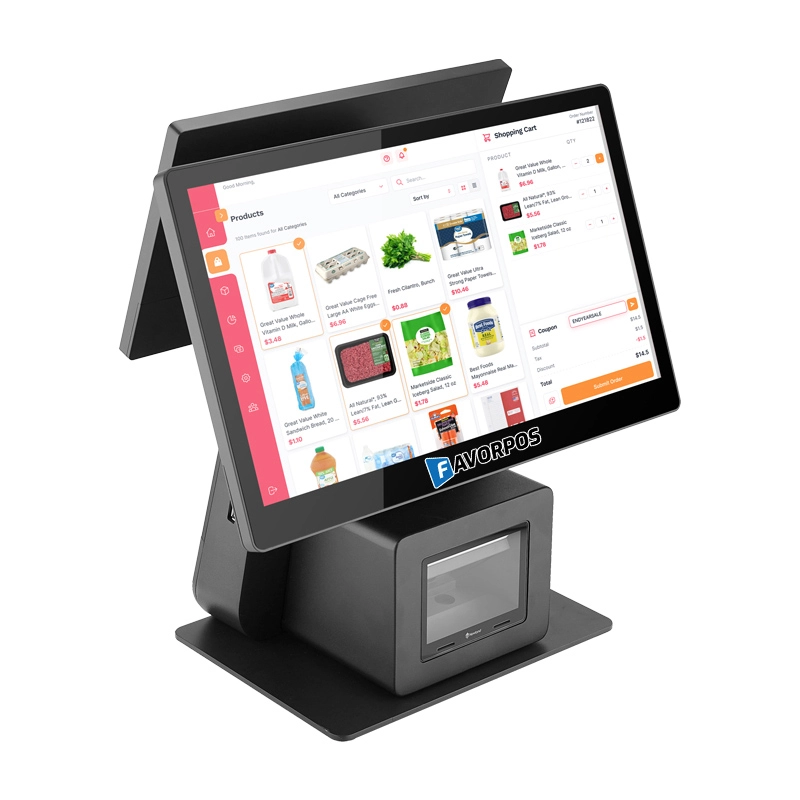
Dual Screen POS With Barcode Scanner Desktop POS Manufacturer POS Factory 15.6 11.6 Client Screen Optional
FAVORPOS: Your leading dual screen POS factory and manufacturer. Our desktop POS with barcode scanner offers 15.6/11.6 client screen options and OS flexibility. Get reliable, efficient dual screen POS with barcode scanner solutions directly from us.
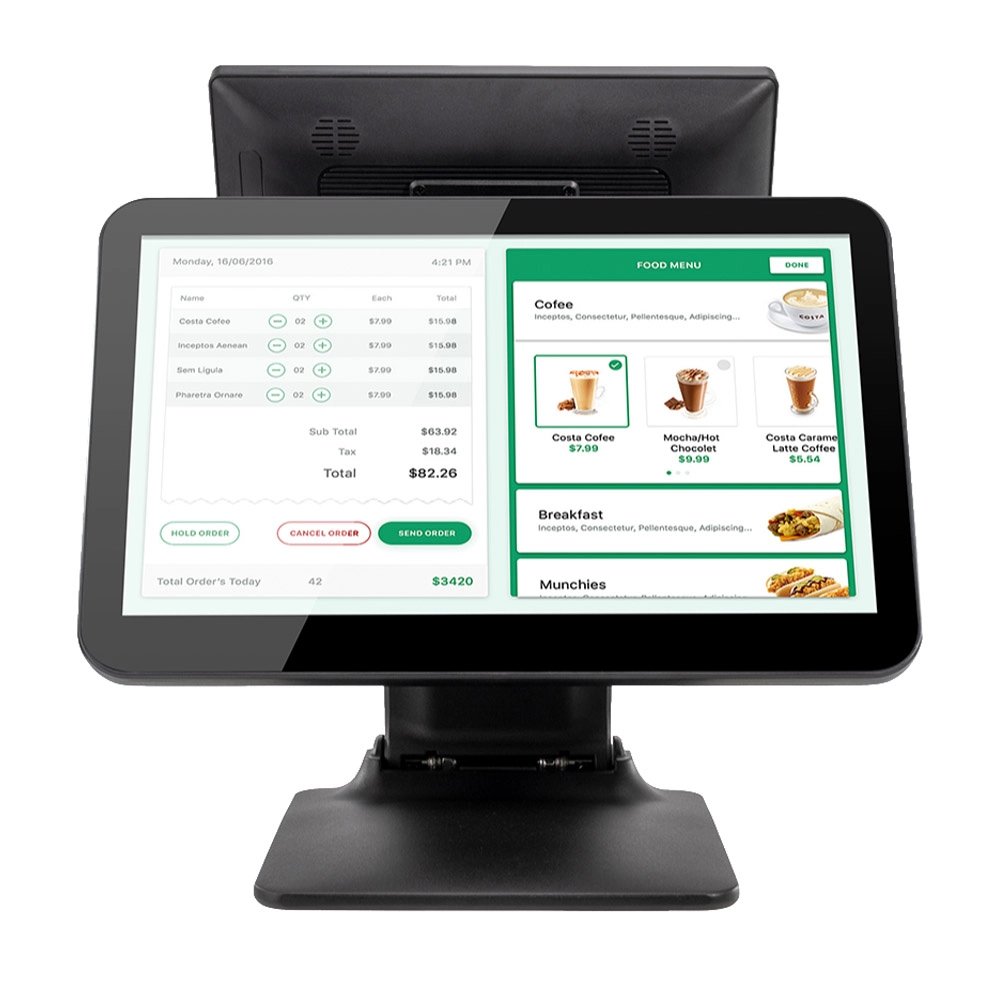
Foldable Touch Screen POS Cash Register 15.6'' Windows Supplier Aluminum
This innovative cash register combines portability with advanced functionality, making it ideal for retail environments. Its aluminum construction ensures durability while maintaining a lightweight design for easy transport and setup. The foldable feature allows for convenient storage and flexibility in various business settings.
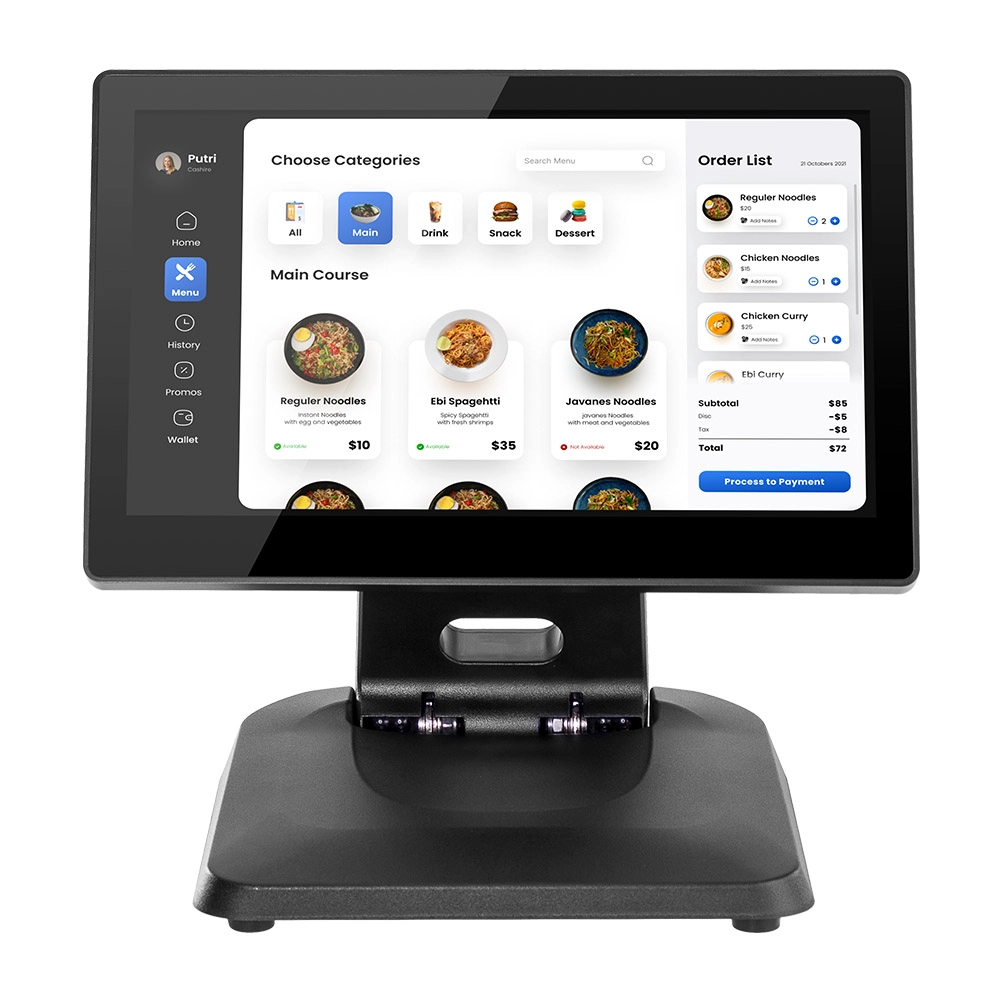
Factory 11.6'' Touch Screen POS Terminal Android Windows
The Factory 11.6'' Touch Screen POS Terminal is a versatile solution that supports both Android and Windows operating systems. Designed for durability and efficiency, this terminal is perfect for various retail environments. Its compact size and responsive touch screen enhance customer interactions, making transactions quick and seamless.
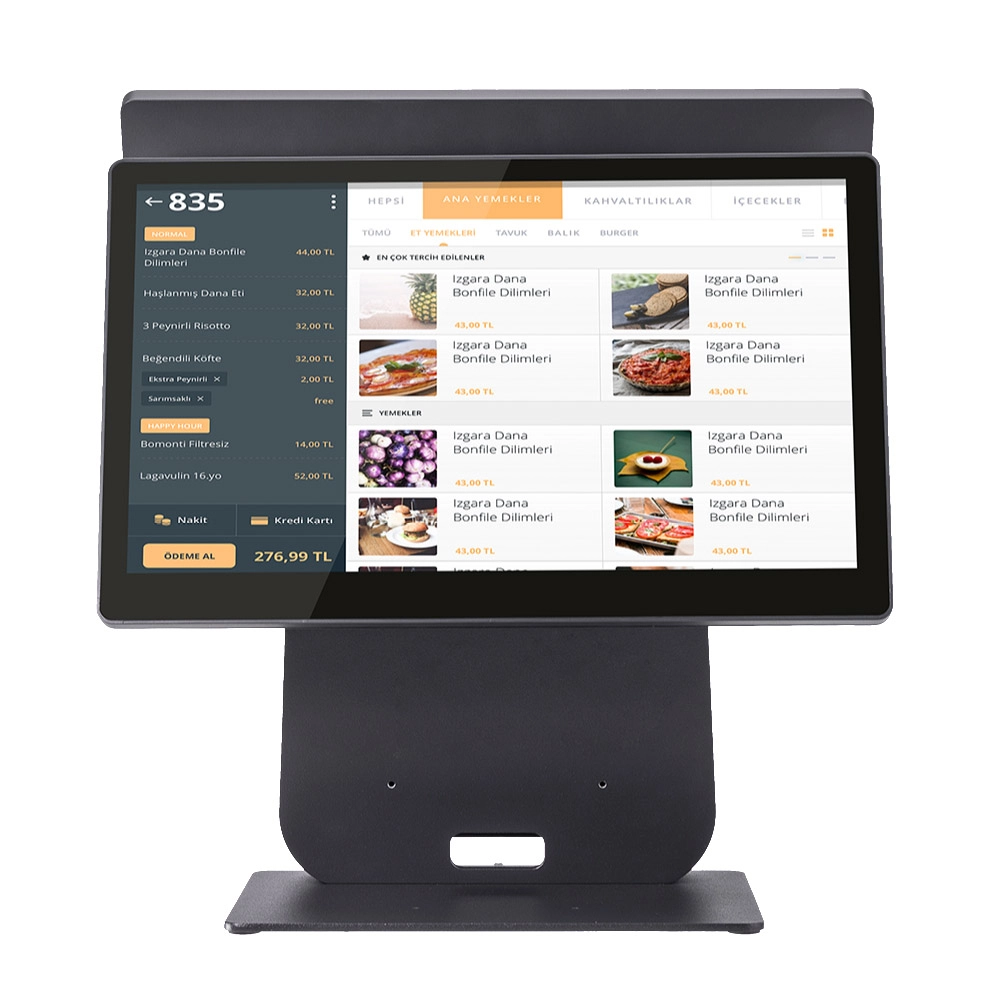
HD Dual Screen POS Machine Aluminum Hardware Android Windows Supplier
This dual-screen POS machine supports both Android and Windows systems, providing flexibility for various applications. The dual screens enhance customer interaction and streamline the checkout process, making transactions quicker and more engaging. Perfect for modern businesses looking to elevate their service and improve customer satisfaction, this POS machine is your ultimate partner in success!


Copyright © 2025 Favorpos All Rights Reserved.
