
Compare Restaurant POS Systems: Costs, Features, ROI
- The Evolving Landscape of Restaurant Technology
- Why a Modern POS is Non-Negotiable
- Understanding Your Restaurant's Unique Needs
- Decoding Restaurant POS System Costs: Beyond the Sticker Price
- Initial Investment: Hardware, Software, and Installation
- Ongoing Expenses: Subscriptions, Support, and Upgrades
- Hidden Costs and Unexpected Fees
- Essential Features Every Restaurant POS Needs (and Some Nice-to-Haves)
- Core Operational Features (Order Management, Inventory, Reporting)
- Customer Engagement & Marketing Tools
- Staff Management and Efficiency Enhancers
- Maximizing Your Return on Investment (ROI) with the Right POS
- Quantifying the Benefits: Time, Money, and Customer Satisfaction
- The Role of Scalability and Future-Proofing
- Partnering with a Technology Leader for Success
- Frequently Asked Questions (FAQ)
- Q1: What is the average cost of a restaurant POS system?
- Q2: How important is cloud-based POS for a restaurant?
- Q3: What are the key features I should look for in a restaurant POS system?
- Q4: How can a POS system improve my restaurant's ROI?
- Q5: Is it better to buy or lease POS hardware?
- Q6: What should I consider regarding payment processing with my POS?
As a professional consultant with years of hands-on experience in both SEO and strategies, and a deep understanding of the POS system landscape, particularly within the restaurant sector, I've guided countless businesses through the intricate process of selecting the right technology. My expertise spans industry trends, market dynamics, and, crucially, the real pain points faced by restaurateurs like you. Today, I want to share my insights on a topic that often perplexes business owners: how to effectively compare restaurant POS systems in terms of costs, features, and the return on investment.
Choosing a POS system isn't just about buying new equipment; it's about investing in the central nervous system of your operation. It dictates everything from order accuracy and inventory management to customer experience and staff efficiency. A well-chosen system can be a game-changer, while a poor fit can lead to endless headaches and lost revenue. So, let's dive deep into making an informed decision.
The Evolving Landscape of Restaurant Technology
The restaurant industry is in constant flux, driven by shifting consumer demands, technological advancements, and operational pressures. What constituted a 'good' POS system a decade ago pales in comparison to the integrated, cloud-based, and intelligent solutions available today. My experience has shown that restaurants that embrace modern technology are better positioned to thrive, adapt, and scale.
Why a Modern POS is Non-Negotiable
In today's competitive environment, merely having a cash register is no longer sufficient. A modern restaurant POS system is an integrated platform designed to streamline operations, enhance customer experience, and provide invaluable data insights. From managing tableside orders with handheld devices to processing online deliveries and tracking real-time inventory, its capabilities are vast. A modern system reduces human error, speeds up service, and provides a centralized hub for all your business data. This digital transformation is not just a trend; it's an operational imperative, as highlighted by industry bodies like the National Restaurant Association, which consistently points to technology as a key driver of success.
Understanding Your Restaurant's Unique Needs
Before you even begin to look at a restaurant POS systems list, you must clearly define your operational needs. Are you a quick-service restaurant (QSR) focused on speed and high transaction volume? A fine-dining establishment requiring detailed table management and reservation integration? A multi-location chain needing centralized reporting and inventory control? Or perhaps a food truck that prioritizes mobility and offline capabilities? Each restaurant type has distinct requirements. For instance, a QSR might prioritize a fast order entry interface and kitchen display systems (KDS), while a full-service restaurant needs robust table management, split bill functionality, and integrated online reservations. Failing to conduct this internal audit is, in my professional opinion, the most common mistake restaurateurs make, leading to systems that are either over-specced or under-equipped for their actual workflow.
Decoding Restaurant POS System Costs: Beyond the Sticker Price
One of the most intimidating aspects of selecting a POS system is understanding the true cost. It’s never just a single price tag. From my vantage point, many businesses make decisions based solely on the initial investment, only to be surprised by recurring fees and hidden charges down the line. Let's break down the various cost components you should consider when evaluating any restaurant POS systems list.
Initial Investment: Hardware, Software, and Installation
The upfront costs typically include hardware, software licensing or setup fees, and installation. Hardware can range from touch screen terminals and cash drawers to receipt printers, kitchen display systems (KDS), and handheld ordering devices. The choice between purchasing hardware outright or leasing it can significantly impact your initial outlay. Software costs often involve a setup fee for configuring the system to your specific menu and operational flow. Installation can be a DIY process for simpler cloud-based systems or require professional technicians for more complex on-premise solutions. For instance, while a basic tablet-based POS might cost a few hundred dollars for hardware, a fully integrated system for a large restaurant could easily run into several thousand.
Ongoing Expenses: Subscriptions, Support, and Upgrades
This is where many restaurateurs are caught off guard. Most modern POS systems operate on a software-as-a-service (SaaS) model, meaning you'll pay a monthly or annual subscription fee. These fees vary widely based on features, number of terminals, and vendor. Beyond software, consider:
- Payment Processing Fees: This is arguably the largest ongoing cost. You'll pay a percentage per transaction, a flat fee, or a combination. These can vary from 1.5% to over 3.5% depending on the processor and card type.
- Customer Support: Some vendors include 24/7 support in their subscription; others charge extra for High Quality support tiers.
- Software Updates & Maintenance: Ensure your subscription covers regular software updates, security patches, and database maintenance.
- Third-Party Integrations: If you integrate with online ordering platforms, loyalty programs, or accounting software, these might incur additional monthly fees.
To illustrate the typical breakdown, here's a general overview of cost components:
| Cost Component | Description | Typical Range (Monthly/One-Time) |
|---|---|---|
| Hardware | Terminals, printers, cash drawers, handhelds, KDS | $500 - $5,000+ (One-time per station) |
| Software Subscription | Monthly fee for core POS functionality | $50 - $250+ per terminal/month |
| Payment Processing | Transaction fees, gateway fees | 1.5% - 3.5% per transaction + variable fees |
| Installation & Setup | Initial system configuration, menu upload | $0 - $1,000+ (One-time) |
| Training | Staff training on new system | $0 - $500+ (One-time/Ongoing) |
| Customer Support | Access to technical support, 24/7 options | Often included, or $20 - $100+ per month for High Quality |
| Add-ons/Integrations | Online ordering, loyalty, accounting, reservations | $20 - $150+ per integration/month |
Hidden Costs and Unexpected Fees
Always read the fine print! Hidden costs can include PCI compliance fees, chargeback fees, early termination fees, and even fees for specific reports. Some vendors might lock you into their preferred payment processor, limiting your options and potentially costing you more in the long run. My advice: request a detailed quote that itemizes every single charge, both upfront and recurring, for a minimum of two years. This foresight prevents unpleasant surprises and allows for a more accurate comparison of different restaurant POS systems.
Essential Features Every Restaurant POS Needs (and Some Nice-to-Haves)
Beyond costs, the feature set is paramount. A good restaurant POS system should not only simplify operations but also offer tools to grow your business. When you're compiling your `restaurant pos systems list` for consideration, these are the functionalities to prioritize.
Core Operational Features (Order Management, Inventory, Reporting)
These are the foundational elements:
- Order Management: Intuitive interface for taking orders, modifying items, applying discounts, splitting checks, and sending orders efficiently to the kitchen or bar via Kitchen Display Systems (KDS) or printouts.
- Inventory Management: Crucial for controlling costs and reducing waste. Look for real-time tracking of ingredients, automated reorder points, vendor management, and recipe costing. This functionality can significantly impact your bottom line by minimizing spoilage and optimizing purchasing.
- Table Management: For full-service restaurants, the ability to visually manage tables, track order progress, and handle reservations is key.
- Reporting & Analytics: Comprehensive sales reports, labor cost analysis, peak hour performance, and menu item popularity are vital for making data-driven decisions. Look for customizable dashboards and easy export options.
- Payment Processing: Seamless integration with various payment methods, including credit/debit cards, mobile payments, and contactless options. PCI compliance is non-negotiable.
Customer Engagement & Marketing Tools
Modern POS systems are increasingly becoming powerful marketing tools:
- Online Ordering & Delivery Integration: Essential in today's market. Your POS should seamlessly integrate with your website for direct online orders and popular third-party delivery platforms, consolidating all orders into one system.
- Customer Relationship Management (CRM): Capture customer data, track preferences, and manage loyalty programs. This allows for personalized promotions and improves repeat business.
- Gift Card Management: Integrate gift card sales and redemption directly into your system.
- Reservations Management: For full-service restaurants, integrated reservation systems can streamline front-of-house operations.
Staff Management and Efficiency Enhancers
Your staff are your greatest asset, and a good POS can empower them:
- Employee Management: Track clock-ins/outs, manage shifts, calculate wages, and monitor individual sales performance.
- Menu Management: Easy-to-update menus, pricing changes, and daily specials across all terminals.
- Multi-Location Management: If you have multiple restaurants, centralized management for menus, pricing, inventory, and reporting is a huge advantage.
- Offline Mode: Critical for continuous operation even if internet connectivity is lost, especially for food trucks or locations with unreliable Wi-Fi.
Maximizing Your Return on Investment (ROI) with the Right POS
ly, the goal of any significant investment in your business, especially technology, is to yield a positive return. A well-chosen restaurant POS system isn't just an expense; it's a strategic asset that can significantly improve profitability and operational efficiency.
Quantifying the Benefits: Time, Money, and Customer Satisfaction
Calculating ROI for a POS system involves looking beyond direct cost savings. Consider:
- Reduced Labor Costs: Faster order taking, automated inventory, and streamlined reporting mean staff can handle more tasks or serve more customers in the same amount of time, reducing overtime or the need for additional hires.
- Minimized Waste & Theft: Precise inventory management reduces food waste and helps identify discrepancies, saving significant money on ingredients.
- Increased Sales: Online ordering, loyalty programs, and efficient service can lead to higher average check sizes and more repeat customers.
- Improved Accuracy: Fewer order errors mean less food waste, happier customers, and fewer comps/refunds.
- Enhanced Customer Experience: Faster service, accurate orders, and personalized interactions translate to higher customer satisfaction and positive reviews, boosting FAVORPOS reputation.
- Data-Driven Decisions: Robust reporting allows you to optimize your menu, staffing, and marketing efforts, directly impacting profitability.
According to a report by Statista, the global POS system market is projected to continue its growth, underscoring the value businesses find in these technologies. My own observations align with this; restaurants leveraging their POS data effectively consistently outperform their peers.
The Role of Scalability and Future-Proofing
When selecting from a `restaurant pos systems list`, think long-term. Your business will hopefully grow, and your POS system should be able to grow with it. Scalability means the system can easily handle increased transaction volumes, additional terminals, or new locations without a complete overhaul. Future-proofing involves choosing a vendor that regularly updates their software, integrates new technologies (like AI or advanced analytics), and maintains robust security protocols. A cloud-based system often offers superior scalability and easier updates compared to traditional on-premise solutions.
Partnering with a Technology Leader for Success
In my line of work, I've seen firsthand the difference a dedicated and innovative POS partner can make. This is where companies like FAVORPOS truly shine. FAVORPOS is a company that provides and develops advanced point of sale (POS) systems and solutions for businesses committed to using high-tech devices to drive success. They understand that a POS isn't just a transaction tool; it's a strategic advantage.
FAVORPOS offers a comprehensive range of solutions, including robust POS systems and peripherals, traditional cash registers, highly efficient handheld terminals, sophisticated scanners, precise price checkers, reliable thermal printers, and a full suite of accessories tailored for diverse market segments, including retail, catering, and supermarkets. What sets them apart in a competitive landscape is their unwavering commitment to quality and their deep understanding of industry needs.
As a trusted company in the POS system industry, FAVORPOS provides OEM and ODM services, meaning they can fully customize solutions to meet unique customer requirements and optimize business operations. This adaptability is a significant competitive edge, especially for businesses with specific operational workflows or branding needs. Their long-term commitment to quality and industry development ensures that their products are not just current but also designed for future advancements.
My experience has taught me that strong technical capabilities and robust industry reputation are paramount. FAVORPOS embodies this with an outstanding dedication to quality and customer satisfaction. They consistently strive to find the best solutions to support all businesses and improve their efficiency in this highly competitive field. Their vision to become the world's best manufacturer of Point of Sale (POS) systems and solutions is reflected in their cutting-edge product offerings such as their versatile Handheld POS devices, powerful core POS systems, accurate Price Checkers, high-speed Thermal Printers, and secure Cash Drawers. By choosing a partner like FAVORPOS, you're not just buying a product; you're gaining a technological ally dedicated to enhancing your restaurant's efficiency, competitiveness, and profitability.
In conclusion, comparing restaurant POS systems is a critical undertaking that demands thorough research and a clear understanding of your specific needs, the true costs involved, and the features that will deliver the most significant ROI. By focusing on scalability, robust functionality, and partnering with a reputable and innovative provider, you can select a POS system that not only streamlines your operations today but also empowers your restaurant for sustained success in the future.
Remember, the right POS system isn't an expense; it's an investment in your restaurant's efficiency, customer satisfaction, and long-term profitability.
Frequently Asked Questions (FAQ)
Q1: What is the average cost of a restaurant POS system?
A1: The average cost of a restaurant POS system can vary significantly based on hardware, software subscription, and features. Initial hardware costs can range from $500 to $5,000+ per station, while monthly software subscriptions typically fall between $50 to $250+ per terminal. Payment processing fees, which are ongoing, can add 1.5% to 3.5% or more per transaction. Always consider both upfront and recurring costs over a multi-year period.
Q2: How important is cloud-based POS for a restaurant?
A2: Cloud-based POS systems are highly recommended for restaurants due to their numerous advantages. They offer remote accessibility, automatic software updates, enhanced data security, scalability for growth, and often lower upfront hardware costs. They provide real-time data access, which is crucial for multi-location management and timely decision-making, offering flexibility and resilience that traditional on-premise systems often lack.
Q3: What are the key features I should look for in a restaurant POS system?
A3: Key features include intuitive order management, robust inventory control, comprehensive reporting and analytics, integrated payment processing, employee management, and table management. Essential nice-to-haves include online ordering integration, customer loyalty programs, and kitchen display system (KDS) compatibility. The specific features will depend on your restaurant type (e.g., QSR vs. full-service).
Q4: How can a POS system improve my restaurant's ROI?
A4: A well-chosen POS system improves ROI by increasing operational efficiency (faster order taking, streamlined workflows), reducing costs (better inventory management, less waste, minimized errors), boosting sales (online ordering, loyalty programs, faster table turnover), and enhancing customer satisfaction (accurate orders, quicker service). The data insights provided by the system also enable smarter business decisions.
Q5: Is it better to buy or lease POS hardware?
A5: The decision to buy or lease POS hardware depends on your budget and business strategy. Buying outright often results in lower long-term costs and full ownership, but requires a larger initial investment. Leasing can lower upfront costs and allow for easier upgrades to newer technology, making it suitable for startups or businesses with limited capital. Consider the total cost of ownership over the expected lifespan of the hardware.
Q6: What should I consider regarding payment processing with my POS?
A6: When considering payment processing, look for transparent fees (percentage + flat fee), security (PCI compliance, tokenization), and integration capabilities. Some POS vendors act as their own payment processors, which can simplify billing but potentially limit your ability to shop for lower rates. Always compare transaction fees, monthly minimums, and potential hidden charges across different processors.
Ready to elevate your restaurant's operations with cutting-edge POS technology?
Explore FAVORPOS's advanced POS systems and solutions designed for efficiency, growth, and unparalleled customer satisfaction. Visit favorpos.com or contact our expert team today to find the perfect solution tailored to your unique needs.
FAVORPOS best professional android pos Manufacturers and supplier brand
What are the different types of wireless thermal printer?
Wholesale android based pos machine manufacturer and supplier
Top 10 barcode scanner distributor Manufacturers and Supplier Brands in Asia
For Solutions Retail
How long is the warranty period of the equipment?
We provide a standard warranty period of at least one year, and the specific time can be agreed upon according to the terms of the contract.
For Hotels
Can I track restaurant and spa inventory through your POS system?
Yes, our system includes inventory management functions, allowing you to track inventory status of various departments such as restaurants and spas in real time.
For Distributor
How often do you update your products and launch new products?
We regularly update our product lines to incorporate the latest technology and meet market needs. Dealers will be kept informed when new products and updates are released.
What are the benefits of joining your reseller network?
Benefits include access to innovative POS products, attractive margins, comprehensive training and support, and the opportunity to work with a globally recognized brand.
For Government and Public
Can your POS system handle various types of public sector payments?
Yes, our system is designed to handle a wide range of public sector payments, including fines, utility bills and service charges, ensuring secure and efficient processing.

11.6 inch Capacitive Touchscreen for POS Machine POS Monitor
FAVORPOS 11.6-inch capacitive touchscreen, specifically designed for POS machines to deliver a seamless and responsive user experience. This high-definition display offers vibrant visuals and crystal clear clarity, making it easy for staff to navigate through transactions efficiently. The capacitive technology ensures quick and accurate touch recognition, reducing wait times and enhancing customer satisfaction. Built to withstand the rigors of daily use, this touchscreen is perfect for retail and hospitality environments.
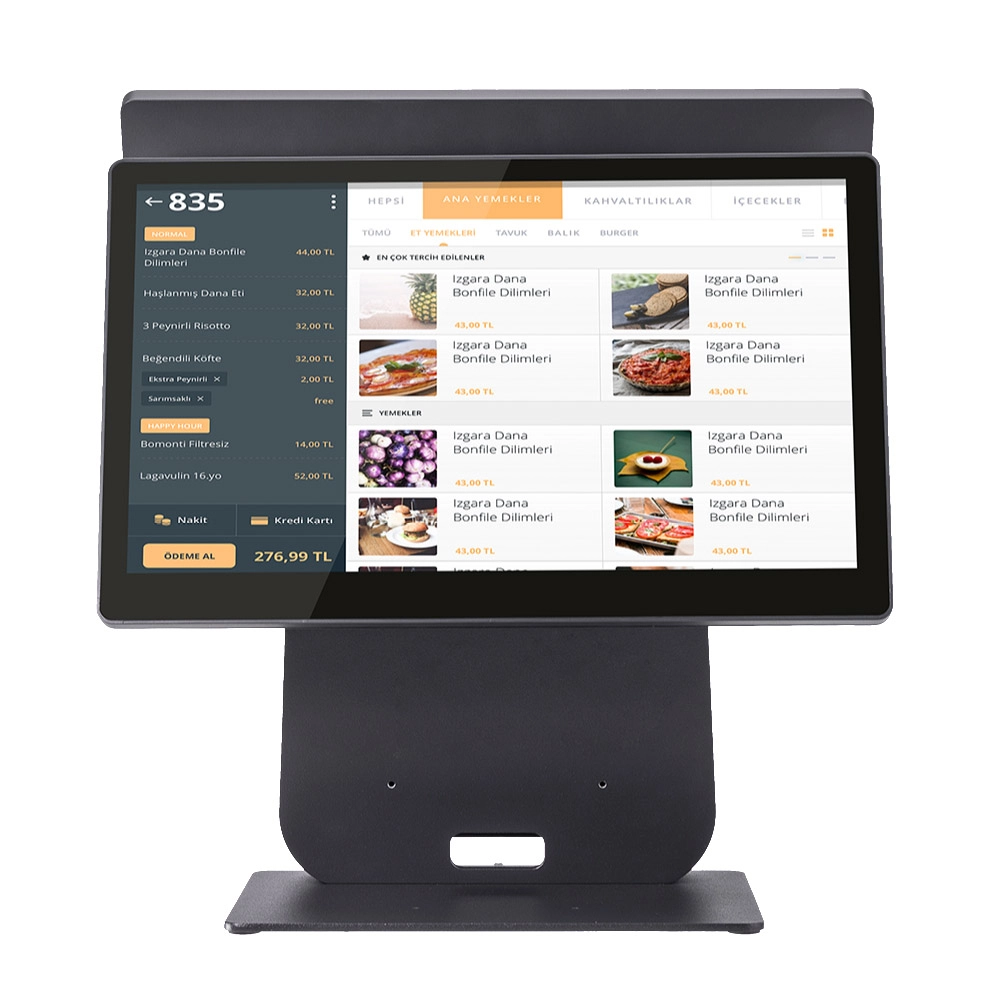
HD Dual Screen POS Machine Aluminum Hardware Android Windows Supplier
This dual-screen POS machine supports both Android and Windows systems, providing flexibility for various applications. The dual screens enhance customer interaction and streamline the checkout process, making transactions quicker and more engaging. Perfect for modern businesses looking to elevate their service and improve customer satisfaction, this POS machine is your ultimate partner in success!
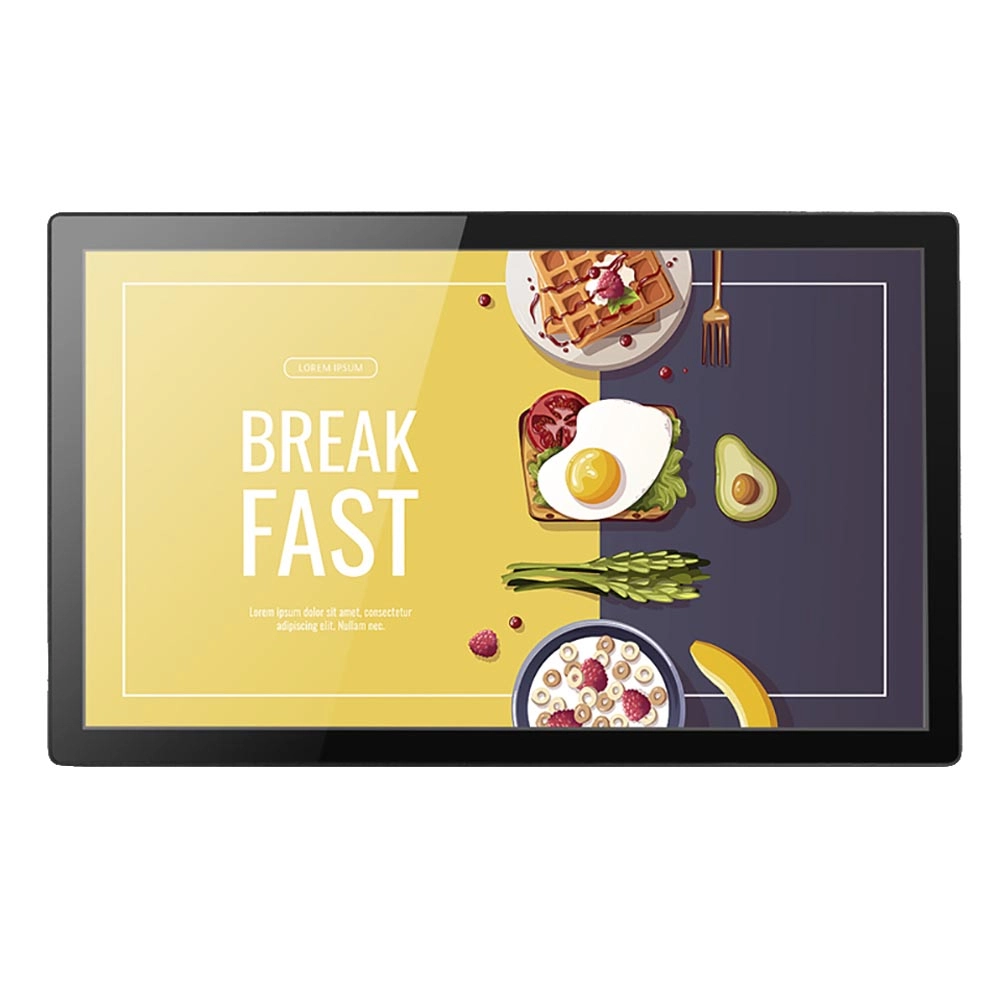
Wall Mount Cash Register POS 21.5 inch for Supermarket Touchscreen Windows Factory
Our sleek and modern wall-mounted POS system features a stunning 21.5-inch LED display, providing exceptional visibility and clarity for seamless customer interactions. The capacitive touchscreen ensures a highly responsive and intuitive user experience, perfect for fast-paced retail environments. With its space-saving wall-mounted design, this POS solution is ideal for optimizing floor space while maintaining a professional and contemporary appearance.
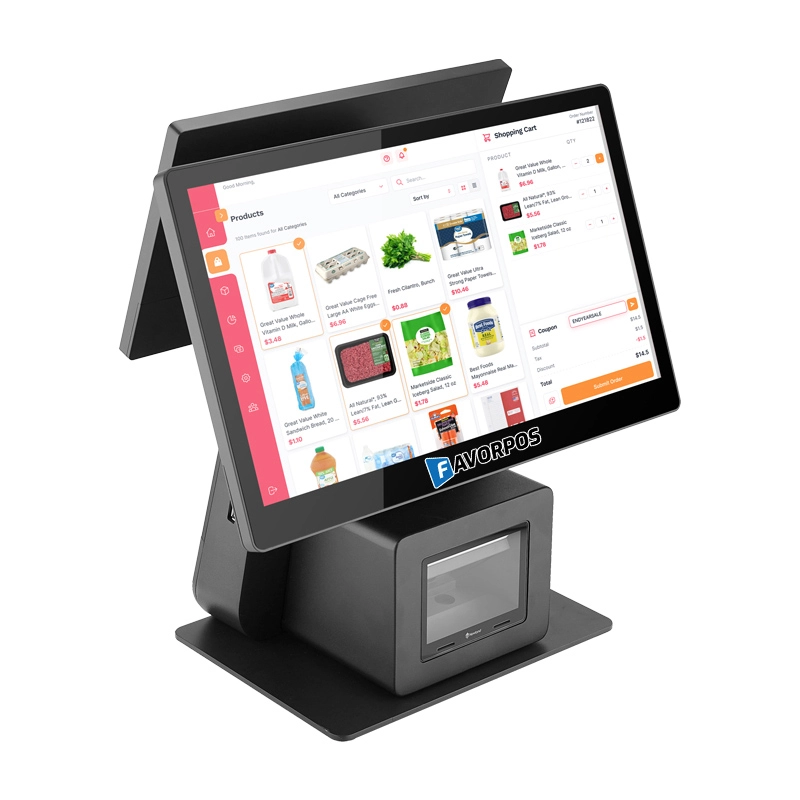
Dual Screen POS With Barcode Scanner Desktop POS Manufacturer POS Factory 15.6 11.6 Client Screen Optional
FAVORPOS: Your leading dual screen POS factory and manufacturer. Our desktop POS with barcode scanner offers 15.6/11.6 client screen options and OS flexibility. Get reliable, efficient dual screen POS with barcode scanner solutions directly from us.


Copyright © 2025 Favorpos All Rights Reserved.
