
Hardware components of a modern POS desktop system explained
- Beyond the Screen: Why Your POS Hardware Foundation Matters
- The Brains of the Operation: Processor and RAM
- Storing Your Business's Lifeblood: Storage Solutions
- The Visual Interface: Touchscreen Displays
- Essential Peripherals: The Hands and Voice of Your POS System
- Printing Transactions: Receipt Printers
- Scanning for Speed: Barcode Scanners
- Securely Handling Cash: Cash Drawers
- Connectivity, Power, and Beyond: Ensuring Seamless Operations
- The Lifelines: Ports and Connectivity
- Powering Your Business: Power Supplies and UPS
- The Unsung Heroes: Specialized Peripherals (Customer Displays, Payment Terminals)
- Choosing the Right POS Hardware: A Strategic Investment
- Durability, Reliability, and Scalability: What to Look For
- FAVORPOS: Empowering Businesses with Advanced POS Solutions
- The FAVORPOS Advantage: Innovation, Customization, and Trust
- Conclusion
- FAQ (Frequently Asked Questions)
- Q1: What is the most critical hardware component in a POS desktop system?
- Q2: Should I choose a modular POS system or an all-in-one POS system?
- Q3: How much RAM does a modern POS desktop system typically need?
- Q4: What's the difference between a 1D and a 2D barcode scanner, and which should I choose?
- Q5: Why is a UPS (Uninterruptible Power Supply) important for a POS system?
In today's fast-paced retail and hospitality environments, a robust and reliable Point of Sale (POS) system is more than just a cash register; it's the central nervous system of your business. As someone deeply entrenched in the POS industry, with years of experience both in developing solutions and advising businesses, I've seen firsthand how critical the underlying hardware components are to a system's performance, longevity, and overall success. This article will demystify the essential hardware elements that constitute a modern pos desktop system, explaining their roles and why understanding them is crucial for making informed investment decisions. From the internal brains to the external peripherals, I'll guide you through what truly powers efficient transactions and seamless operations, ensuring your business thrives.
For businesses aiming for peak operational efficiency and customer satisfaction, a high-performing pos desktop system is non-negotiable. The right hardware ensures speed, reliability, and the ability to integrate with various business tools, making it a cornerstone for growth. This deep dive into POS hardware is designed to equip you with the knowledge to select, maintain, and optimize your system for maximum return on investment and to meet the evolving demands of modern commerce, leveraging insights from my extensive experience in the field.
Beyond the Screen: Why Your POS Hardware Foundation Matters
When we talk about a pos desktop system, many immediately picture the touchscreen display. While that's a crucial interface, the true power and reliability lie in the components beneath the surface. Think of it like a high-performance vehicle: you see the sleek exterior, but it's the engine, transmission, and chassis that dictate its capabilities. For a POS, these foundational hardware components determine its speed, stability, and ability to handle the daily grind of transactions, inventory management, and customer interactions.
The Brains of the Operation: Processor and RAM
At the heart of every modern pos desktop system are its processor (CPU) and Random Access Memory (RAM). These two components work in tandem to execute software instructions, process data, and manage multiple tasks simultaneously. A slow processor or insufficient RAM can lead to frustrating delays, crashes, and a poor user experience, directly impacting transaction speed and staff efficiency.
- Processor (CPU): Often referred to as the 'brain,' the CPU performs all the calculations and logic operations. For a POS, you'll typically encounter Intel Celeron, i3, i5, or i7 processors, or their AMD Ryzen equivalents.
- Celeron/i3: Suitable for basic, single-application POS setups with light transaction volumes.
- i5/Ryzen 5: Ideal for medium to high-volume businesses, capable of running multiple applications (e.g., POS software, inventory, loyalty programs) concurrently without significant slowdowns.
- i7/Ryzen 7: Best for demanding environments requiring extensive data processing, complex analytics, or multiple integrated peripherals.
- RAM (Random Access Memory): This is your system's short-term memory, where data actively being used by the CPU is stored for quick access. The more RAM your POS has, the more applications it can run smoothly and the faster it can switch between tasks.
- 4GB: Minimum for very basic POS operations.
- 8GB: Recommended for most modern POS systems, allowing for smoother multitasking and better performance with typical POS software suites.
- 16GB+: Beneficial for highly integrated systems, those running resource-intensive applications, or future-proofing.
The number of cores and clock speed (measured in GHz) also play a vital role. More cores mean better multitasking capabilities, while higher clock speeds translate to faster individual task execution. For a deeper understanding of how CPUs work, you can refer to Wikipedia's explanation of CPUs.
Modern POS systems typically use DDR4 or the newer DDR5 RAM, offering improved speed and efficiency. Understanding RAM's role is crucial for system responsiveness, as detailed in Wikipedia's RAM overview.
Storing Your Business's Lifeblood: Storage Solutions
Beyond temporary memory, your pos desktop system needs permanent storage for the operating system, POS software, transaction logs, product databases, and customer information. The choice of storage significantly impacts system boot times, application loading speeds, and data integrity.
Here's a comparison of common storage types:
| Feature | Hard Disk Drive (HDD) | Solid State Drive (SSD) - SATA | Solid State Drive (SSD) - NVMe |
|---|---|---|---|
| Technology | Mechanical spinning platters | Flash memory chips | Flash memory chips (PCIe interface) |
| Speed (Read/Write) | Slow (50-150 MB/s) | Medium (300-550 MB/s) | Very Fast (1,000-7,000 MB/s) |
| Durability | Vulnerable to drops/shocks | Highly durable, no moving parts | Highly durable, no moving parts |
| Noise | Audible (spinning platters) | Silent | Silent |
| Power Consumption | Higher | Lower | Lowest |
| Cost per GB | Lowest | Medium | Highest |
| Typical Use in POS | Legacy systems, large data archives (less common now) | Standard for modern POS, good balance of cost/performance | High-end POS, demanding applications, future-proofing |
For a modern pos desktop system, I strongly recommend an SSD, preferably an NVMe SSD if the budget allows. The speed and durability benefits far outweigh the slightly higher cost, leading to faster boot times, quicker application launches, and greater resistance to physical wear and tear in a busy commercial environment. Always ensure robust data backup solutions are in place, regardless of your primary storage choice.
The Visual Interface: Touchscreen Displays
The touchscreen display is the primary point of interaction for your staff. Its quality directly impacts ease of use, speed of service, and staff training time. A good POS display is durable, responsive, and clear.
- Types:
- Resistive: Older technology, responds to pressure, can be used with gloves, but less sensitive and prone to wear.
- Capacitive (Projected Capacitive/PCAP): Modern standard, responds to finger touch (like a smartphone), highly sensitive, durable, and supports multi-touch gestures. This is what I recommend for virtually all new pos desktop system deployments.
- Size and Resolution: Common sizes range from 10 to 21 inches. Higher resolution (e.g., 1920x1080 Full HD) provides sharper images and more screen real estate, which is beneficial for complex POS software interfaces.
- Durability: Look for industrial-grade screens designed for continuous use, often with spill-resistant or even waterproof ratings, crucial for hospitality and food service environments.
Essential Peripherals: The Hands and Voice of Your POS System
While the core unit provides the processing power, it's the peripherals that allow your pos desktop system to interact with the physical world of transactions, inventory, and customers. These are the tools that enable your staff to efficiently serve customers and manage sales.
Printing Transactions: Receipt Printers
A receipt printer is a fundamental component, providing customers with a record of their purchase and often serving as a kitchen printer in restaurants. The choice of printer impacts speed, cost of consumables, and environmental noise.
| Feature | Thermal Printer | Dot Matrix Printer |
|---|---|---|
| Technology | Uses heat to print on special thermal paper | Uses pins to strike an ink ribbon onto plain paper |
| Speed | Very Fast (up to 300mm/sec) | Slow (5-10 lines/sec) |
| Noise | Silent | Noisy |
| Consumables | Thermal paper rolls (no ink) | Plain paper rolls, ink ribbons |
| Durability of Print | Fades over time, sensitive to heat/light | Long-lasting print |
| Cost | Higher initial cost, lower running cost | Lower initial cost, higher running cost (ribbons) |
| Typical Use in POS | Most common for receipts, fast-paced retail/hospitality | Kitchen printers (can handle heat/grease, multiple copies), long-term archival needs |
For most modern pos desktop system setups, a thermal printer is the preferred choice due to its speed, silence, and lower running costs. Connectivity options include USB, Ethernet (for network printing), and Bluetooth.
Scanning for Speed: Barcode Scanners
Barcode scanners are indispensable for inventory management, pricing accuracy, and speeding up the checkout process. They minimize manual entry errors and enhance efficiency.
- Types:
- Handheld: Most common, versatile for scanning items of various sizes.
- Presentation (Omnidirectional): Fixed on a counter, allows items to be passed over it from any angle, ideal for high-volume retail.
- In-counter: Integrated into the checkout counter, often combined with scales, for maximum efficiency.
- Barcode Types:
- 1D (Linear): For traditional UPC/EAN barcodes.
- 2D (QR Code, Data Matrix): Can read more complex codes, including those on mobile phones, crucial for loyalty programs or digital coupons.
- Connectivity: USB is standard, with some offering wireless (Bluetooth) options for greater flexibility.
Securely Handling Cash: Cash Drawers
Despite the rise of digital payments, cash remains a significant payment method for many businesses. A secure and reliable cash drawer is essential for managing cash transactions and deterring theft.
- Construction: Typically made of durable steel, with a robust locking mechanism.
- Compartments: Configurable inserts for various denominations of bills and coins.
- Integration: Most cash drawers connect directly to the receipt printer via an RJ11/RJ12 cable, opening automatically upon a cash transaction. This integration is a standard feature of any comprehensive pos desktop system.
- Security: Look for models with multiple lock positions (locked, open, online) and sturdy construction to protect your cash.
Connectivity, Power, and Beyond: Ensuring Seamless Operations
The best hardware components are only as good as their ability to communicate and remain powered. Connectivity and power solutions are often overlooked but are absolutely vital for a reliable pos desktop system.
The Lifelines: Ports and Connectivity
A modern pos desktop system needs a variety of ports to connect all the essential peripherals and integrate with your network. The availability and type of ports dictate the flexibility and expandability of your system.
- USB Ports (2.0, 3.0, Type-C): Ubiquitous for connecting scanners, keyboards, mice, and external storage. USB 3.0 and Type-C offer faster data transfer speeds.
- Ethernet (RJ45): Essential for a stable wired network connection, crucial for cloud-based POS systems and multi-terminal setups.
- Serial Ports (RS232): Still found on many POS systems for connecting older peripherals like certain barcode scanners, scales, or customer displays, known for their reliability over long cable runs.
- Video Ports (HDMI, VGA, DisplayPort): For connecting the primary display and potentially a secondary customer-facing display.
- Wireless Connectivity (Wi-Fi, Bluetooth): Wi-Fi provides network access without cables, useful for mobile POS or where wiring is difficult. Bluetooth connects wireless peripherals like certain scanners or payment terminals.
Ensuring adequate and appropriate ports is key to avoiding compatibility issues and enabling future upgrades for your pos desktop system.
Powering Your Business: Power Supplies and UPS
Consistent, clean power is non-negotiable for a POS system. Power fluctuations or outages can lead to data corruption, hardware damage, and lost sales.
- Internal vs. External Power Supplies: Many POS terminals have internal power supplies, reducing cable clutter. External 'power bricks' are also common, offering easier replacement if they fail.
- Uninterruptible Power Supply (UPS): This is a critical investment. A UPS provides battery backup power during outages, allowing your pos desktop system to shut down gracefully or continue operating for a short period. This prevents data loss and protects hardware from sudden power surges or drops. Leading UPS manufacturers like APC or Eaton offer reliable solutions tailored for business environments.
The Unsung Heroes: Specialized Peripherals (Customer Displays, Payment Terminals)
These components enhance the customer experience and ensure secure payment processing.
- Customer-Facing Displays: Often small LCD screens that show transaction totals, item details, and can even display promotional messages, improving transparency and engagement.
- Integrated Payment Terminals: These devices handle credit/debit card transactions, supporting EMV chip cards, NFC (contactless payments like Apple Pay/Google Pay), and sometimes magnetic stripe cards. Integration with your pos desktop system is crucial for speed, accuracy, and compliance with security standards like PCI DSS. The global standard for chip cards is managed by EMVCo.
Choosing the Right POS Hardware: A Strategic Investment
Selecting the right hardware for your pos desktop system isn't just about ticking boxes; it's a strategic investment in your business's future. It impacts operational efficiency, customer satisfaction, and your ability to adapt to market changes.
Durability, Reliability, and Scalability: What to Look For
When evaluating POS hardware, I always advise clients to consider these three pillars:
- Durability: POS systems operate in demanding environments. Look for industrial-grade components, fanless designs (which reduce dust ingress and noise), and robust casings. This minimizes downtime and extends the lifespan of your investment.
- Reliability: A system that frequently crashes or experiences glitches is a drain on resources and customer patience. Opt for reputable brands with proven track records. Check for features like solid-state storage and efficient cooling.
- Scalability: Can your chosen pos desktop system grow with your business? Does it have enough ports for future peripherals? Can its software be upgraded? Modular designs often offer better scalability. Consider the Total Cost of Ownership (TCO) – a cheaper initial purchase might cost more in maintenance and replacements down the line.
FAVORPOS: Empowering Businesses with Advanced POS Solutions
In my journey through the POS industry, I've seen many providers, but companies like FAVORPOS stand out due to their commitment to high-tech devices and driving business success. FAVORPOS is a company that provides and develops advanced point of sale (POS) systems and solutions for businesses that are committed to using high-tech devices to drive success. Our current solutions include POS systems and peripherals, cash registers, handheld terminals and scanners, price checkers, thermal printers, and accessories for different market segments such as retail, catering, supermarkets, etc. This comprehensive range means they can equip a diverse array of businesses with the precise hardware they need, from a compact Handheld POS for mobile sales to a robust POS system for a busy supermarket checkout.
As a trusted company in the POS system industry, FAVORPOS provides OEM and ODM services to fully meet customer needs and optimize their business operations. This is a significant differentiator, allowing businesses to obtain highly customized hardware solutions that perfectly align with their unique operational requirements and brand identity. They don't just sell off-the-shelf products; they partner with businesses to create tailored solutions. We have a long-term commitment to quality and industry development, which translates into reliable, cutting-edge products that stand the test of time.
The FAVORPOS Advantage: Innovation, Customization, and Trust
With an outstanding dedication to quality and customers, FAVORPOS always strives to find the best solutions to support all businesses and improve their efficiency in this highly competitive field. Their focus on high-tech devices means they are constantly integrating the latest advancements in processors, storage, and connectivity into their pos desktop system offerings, ensuring businesses benefit from superior speed and reliability. Their ability to provide OEM and ODM services means they can address specific user pain points by designing hardware that is perfectly optimized for a particular environment or software, offering a level of customization that many competitors cannot match.
FAVORPOS’s vision is to become the world's best manufacturer of Point of Sale (POS) systems and solutions. This ambition is backed by a robust product portfolio that includes not only core POS system units but also essential peripherals like advanced Price Checker devices for customer convenience, high-speed Thermal Printer units for efficient receipt generation, and secure Cash Drawer solutions. Their commitment to quality, combined with their technical expertise and ability to offer tailored solutions, firmly establishes them as a reputable and competitive player in the industry, providing businesses with the trust and reliability they need in their POS hardware. You can explore their offerings further at https://www.favorpos.com/.
Conclusion
Understanding the hardware components of a modern pos desktop system is no longer a niche technical concern; it's a fundamental aspect of running a successful business. From the processing power of the CPU and the speed of SSD storage to the efficiency of thermal printers and the security of cash drawers, each component plays a vital role in creating a seamless, reliable, and efficient operational environment. By investing in quality, durable, and scalable hardware, businesses can minimize downtime, enhance customer satisfaction, and future-proof their operations against evolving market demands. My experience has shown me that a well-chosen POS hardware setup is not an expense, but an invaluable asset that drives productivity and profitability. Make informed choices, and your POS system will be a cornerstone of your success for years to come.
FAQ (Frequently Asked Questions)
Q1: What is the most critical hardware component in a POS desktop system?
While all components are important, I would argue that the processor (CPU) and storage (SSD) are the most critical. The CPU dictates the system's overall speed and multitasking capability, directly impacting transaction processing time. An SSD, especially NVMe, ensures fast boot-up, quick application loading, and robust data handling, which are crucial for maintaining efficiency and data integrity in a busy retail or hospitality setting.
Q2: Should I choose a modular POS system or an all-in-one POS system?
The choice depends on your specific needs. Modular POS systems (separate monitor, CPU, and peripherals) offer greater flexibility for upgrades, easier component replacement, and customization. They are ideal for businesses that anticipate future hardware changes or have specific peripheral requirements. All-in-one POS systems integrate the CPU and display into a single unit, offering a cleaner aesthetic, smaller footprint, and simpler installation. They are often preferred for space-constrained environments or businesses seeking a streamlined, plug-and-play solution. From my perspective, modular systems often offer better long-term scalability and repairability.
Q3: How much RAM does a modern POS desktop system typically need?
For most modern POS desktop systems running standard POS software and a few background applications, 8GB of RAM is generally recommended as a good balance between performance and cost. For more demanding environments, such as those running multiple resource-intensive applications, complex loyalty programs, or extensive inventory management, 16GB or more would provide a noticeable performance boost and better future-proofing.
Q4: What's the difference between a 1D and a 2D barcode scanner, and which should I choose?
1D barcode scanners read traditional linear barcodes (like UPC/EAN codes), which are common on most retail products. 2D barcode scanners can read more complex, two-dimensional codes such as QR codes and Data Matrix codes, which can store more information and are often used for digital coupons, loyalty programs on smartphones, or inventory tracking. I recommend choosing a 2D barcode scanner for a modern POS system. While slightly more expensive, it offers greater versatility, future-proofs your system, and allows you to process a wider range of items and digital promotions, enhancing customer experience.
Q5: Why is a UPS (Uninterruptible Power Supply) important for a POS system?
A UPS is incredibly important because it provides battery backup power to your POS system in the event of a power outage or fluctuation. This prevents sudden shutdowns, which can lead to data corruption, loss of unsaved transactions, and potential damage to hardware components. A UPS allows for a graceful system shutdown or continued operation for a short period, ensuring business continuity and protecting your valuable data and hardware investment. It's a small investment that can prevent significant disruptions and costs.
Ready to elevate your business with cutting-edge POS hardware?
Don't let outdated or unreliable hardware hold your business back. Explore FAVORPOS's advanced range of POS systems and peripherals, including Handheld POS, Price Checkers, Thermal Printers, and Cash Drawers, designed for durability, efficiency, and seamless integration. Visit https://www.favorpos.com/ today to learn more about our OEM/ODM services and find the perfect solution to optimize your operations and drive success. Our experts are ready to help you build the ideal POS foundation.
Top 10 best touch screen pos system Manufacturers and Supplier Brands in Europe
The pos tablet stand Cost Guide
FAVORPOS best professional best pos systems for retail stores Manufacturers and supplier brand
What is cash register with cash drawer ?
For Healthcare
What payment methods does the POS system support?
Our POS system supports a variety of payment methods, including credit/debit cards, mobile payments, contactless payments, and integration with insurance bills.
For Solutions Retail
Can your equipment support multiple languages and currencies?
Yes, our POS system supports multi-language operation interfaces and multi-currency transactions to meet the needs of the global market. You can set different language and currency options according to the specific requirements of the country or region where your business is located.
What payment methods do your POS devices support?
Our POS devices support a variety of payment methods, including credit cards, debit cards, NFC (near field communication) mobile payments, QR code payments, Apple Pay, Google Pay, etc., ensuring that your customers have a variety of payment options.
For OEM
What is the minimum order quantity for customizing POS machines?
The minimum order quantity (MOQ) usually depends on the specific customization requirements and production scale. We recommend that you contact our sales representative to discuss your project requirements so that we can provide the most suitable production plan and MOQ.
For E-commerce
What kind of support do you provide after the system is implemented?
We provide 24/7 technical support, regular firmware updates, and ongoing maintenance to ensure that the system always maintains optimal performance.
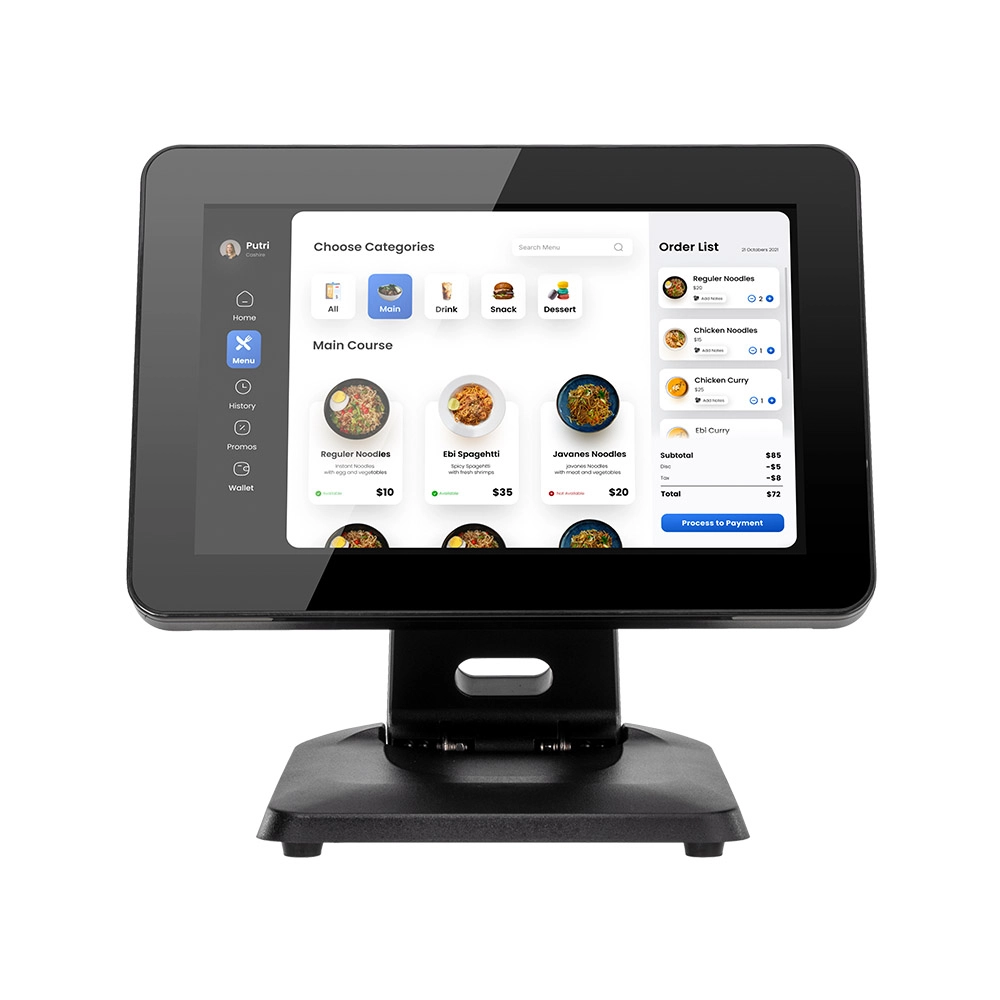
Desktop Touch Screen POS Systems 12.1'' Android Windows Manufacturer
Our Desktop Touch Screen POS Systems feature a 12.1'' display, supporting both Android and Windows platforms. Engineered for high performance. The intuitive touch interface simplifies transactions and enhances customer engagement. With a sleek design and robust construction, our POS systems are perfect for businesses looking to improve efficiency and elevate the shopping experience.
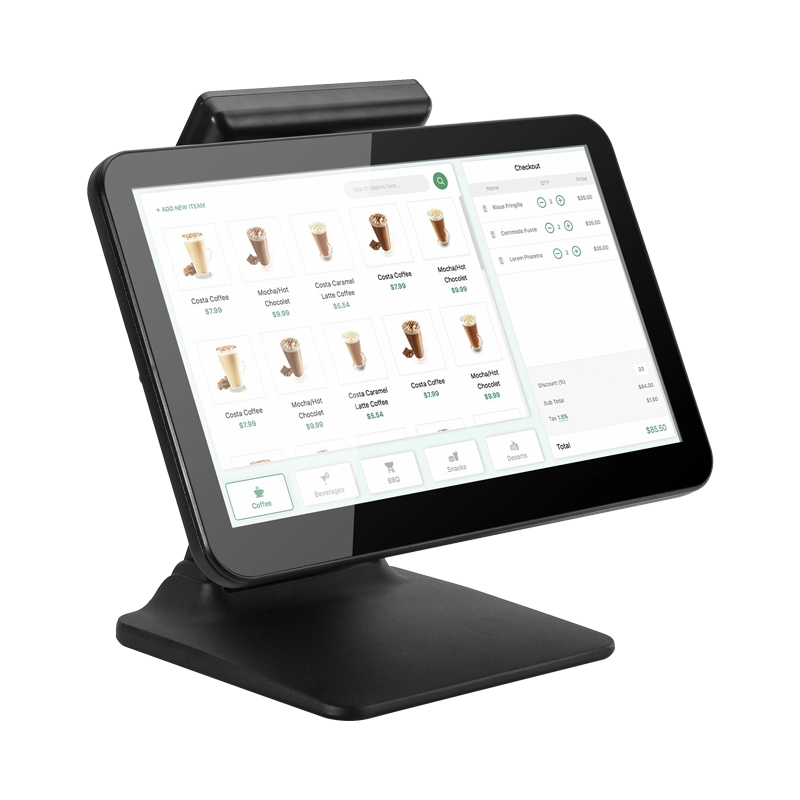
15.6 Inch Windows POS Terminal with VFD Display, Foldable Aluminum Stand Touch Screen POS for Retail & Hospitality
This 15.6-inch POS terminal is built to meet the needs of modern retail and hospitality environments. Powered by a stable Windows operating system, it ensures smooth performance for various point-of-sale applications. The device features a crisp, responsive touch screen and a built-in VFD customer display, allowing customers to view transaction details clearly. Its aluminum alloy stand offers a sleek, professional appearance while providing enhanced durability and stability for busy checkout counters. Ideal for retail stores, restaurants, and service-based businesses, this POS machine delivers a reliable and customer-friendly checkout experience.
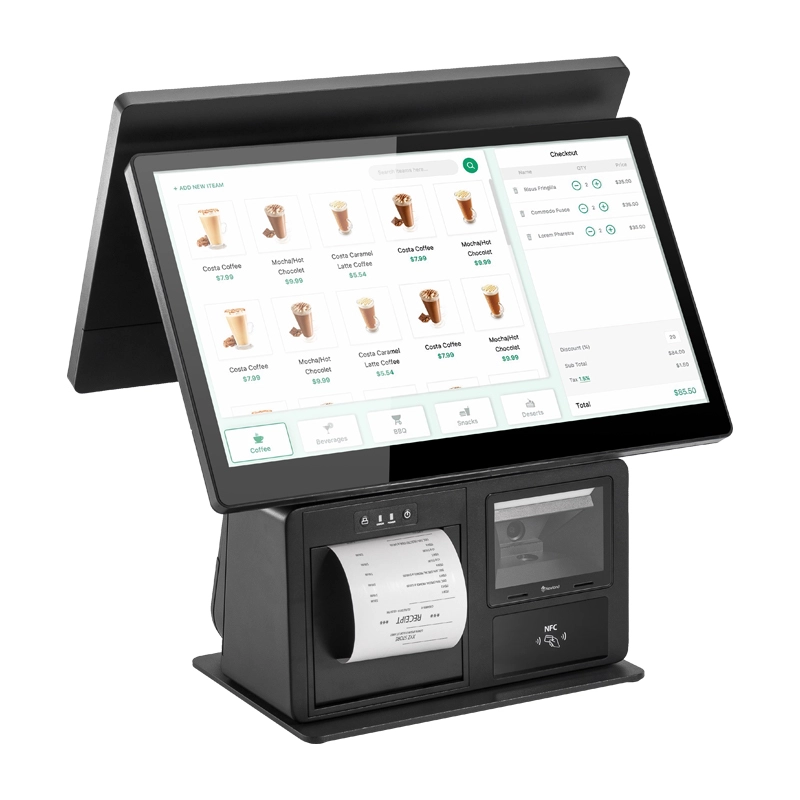
Point of Sale System with Thermal Printer All in One Pos Dual Touchscreen Pos with Barcode Scanner Supplier
FAVORPOS presents the all-in-one Point of Sale System with Thermal Printer, featuring dual touchscreens and an integrated barcode scanner. As a leading POS with NFC factory and barcode scanner supplier, we deliver reliable, efficient solutions tailored for your business needs.
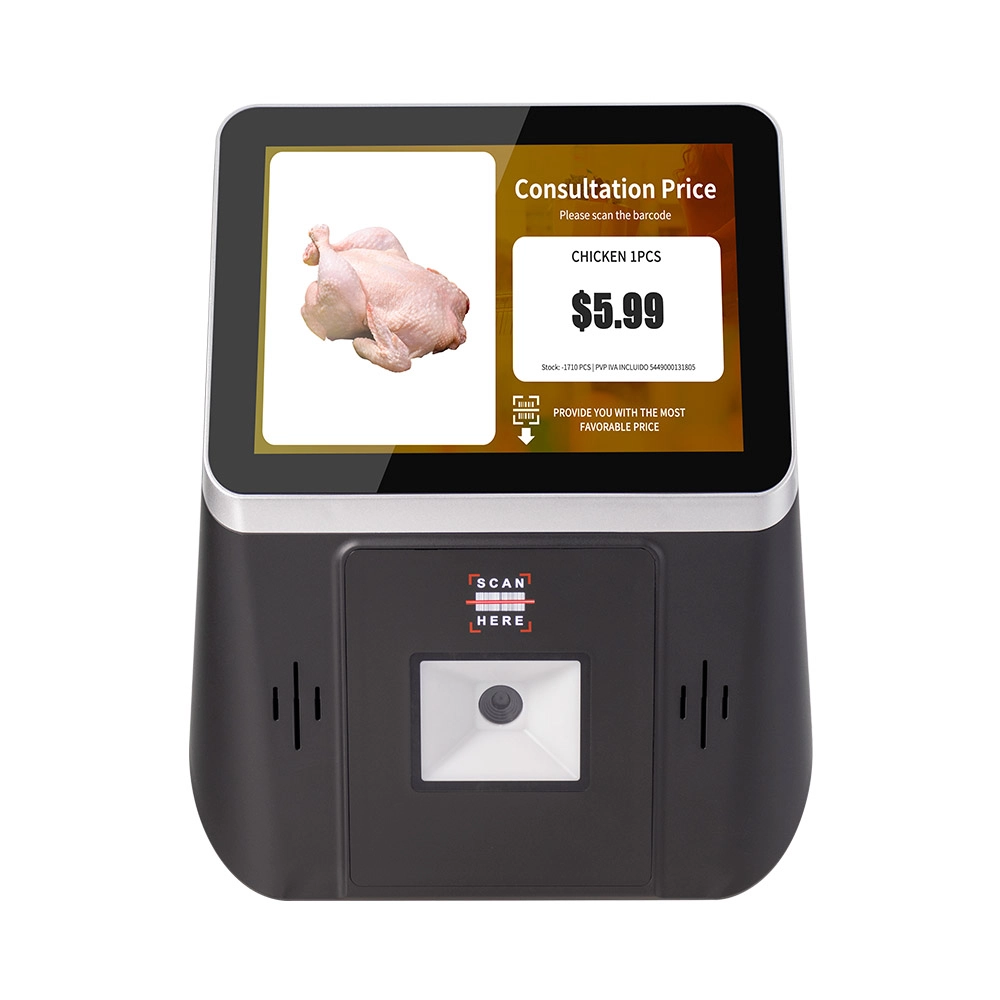
8 inch Wall Mount Price Checker with Scanner Android Windows Factory
Our 8-inch Wall Mount Price Checker is designed for optimal convenience in retail spaces, featuring a sleek design that fits seamlessly into any environment. Compatible with both Android and Windows, this unit includes an integrated scanner for quick and accurate price checks. Its wall-mounted design saves counter space while providing easy access for customers. Ideal for enhancing efficiency and improving the shopping experience.


Copyright © 2025 Favorpos All Rights Reserved.
