
POS Security & PCI Compliance for Restaurants
- Navigating the Modern Restaurant's Digital Frontier
- The Interconnected Restaurant Ecosystem and Its Vulnerabilities
- The Real Cost of a Data Breach for Restaurants
- Demystifying PCI DSS Compliance for Restaurants
- What is PCI DSS and Why Is It Critical for Your Restaurant?
- The 12 Core Requirements of PCI DSS
- Understanding PCI Compliance Levels for Restaurants
- Implementing Robust POS Security Measures
- Secure Payment Processing Technologies: Encryption and Tokenization
- Network Security Best Practices for Restaurants
- Employee Training and Human Factor Security
- Choosing and Optimizing Your Restaurant's POS System for Security
- Key Security Features to Look for in a POS System
- Leveraging Advanced POS Solutions for Enhanced Protection
- Regular Security Audits and Incident Response Planning
- Conclusion: A Secure Future for Your Restaurant
- Frequently Asked Questions (FAQs)
- Ready to Fortify Your Restaurant's Security?
As a professional deeply immersed in the world of POS systems, , and digital security for businesses, I've witnessed firsthand how rapidly the restaurant industry is evolving. The integration of technology, particularly advanced POS systems, has become the backbone of efficient operations, streamlined orders, and enhanced customer experiences. Yet, with great technological power comes great responsibility—specifically, the responsibility of safeguarding sensitive data and ensuring impenetrable POS security and PCI compliance for restaurants.
For any restaurant owner navigating this digital age, the question isn't whether a data breach *can* happen, but rather, what measures are in place to prevent one and mitigate its impact. Customer trust, brand reputation, and financial stability all hinge on the strength of your security posture. This article will serve as your essential guide, drawing upon my extensive experience to help you understand the critical importance of secure payment processing, the intricacies of PCI DSS compliance, and how to implement best practices to protect your restaurant, your customers, and your future.
Navigating the Modern Restaurant's Digital Frontier
The restaurant industry, once characterized by cash transactions and handwritten orders, has undergone a profound digital transformation. Today, top restaurant POS systems are at the heart of daily operations, managing everything from inventory and staff scheduling to table management and customer loyalty programs. This shift, while immensely beneficial for efficiency and growth, has simultaneously introduced a complex array of cybersecurity challenges that demand vigilant attention.
The Interconnected Restaurant Ecosystem and Its Vulnerabilities
A modern restaurant's digital ecosystem is a web of interconnected devices and software: your central POS terminal, handheld POS devices for tableside ordering, kitchen display systems, online ordering platforms, payment processors, and loyalty program databases. Each connection point, while facilitating seamless operations, can also represent a potential vulnerability if not properly secured. For instance, an unsecured Wi-Fi network used by guests could provide an entry point for cybercriminals to access your internal network. Outdated software on a POS terminal might harbor known exploits that hackers can leverage. The complexity means a multi-layered security approach is absolutely essential.
The Real Cost of a Data Breach for Restaurants
Many restaurant owners might underestimate the devastating impact of a data breach. It's not just about fines—though those can be substantial. A breach can lead to:
- Erosion of Customer Trust: Customers will hesitate to dine at an establishment that has proven unable to protect their payment information. Rebuilding this trust is an arduous and often lengthy process.
- Significant Financial Penalties: Non-compliance with PCI DSS can result in hefty fines from payment card brands and acquiring banks, ranging from $5,000 to $100,000 per month until compliance is achieved.
- Legal Liabilities and Lawsuits: Affected customers, banks, and payment card brands may pursue legal action, adding immense legal costs and reputational damage.
- Operational Disruptions: Forensic investigations, system clean-ups, and security overhauls can halt operations, leading to lost revenue.
- Reputational Damage: News of a breach spreads quickly, damaging FAVORPOS's image and potentially leading to long-term revenue loss.
The average cost of a data breach continues to rise globally. While specific figures for restaurants vary, the 2023 IBM Cost of a Data Breach Report noted that the average cost of a data breach was $4.45 million. While this is an aggregate across industries, smaller businesses like restaurants are often less equipped to handle the financial and operational fallout, making prevention paramount.
Demystifying PCI DSS Compliance for Restaurants
The Payment Card Industry Data Security Standard (PCI DSS) is not merely a suggestion; it's a non-negotiable set of requirements for any entity that processes, stores, or transmits credit card information. For restaurants, understanding and adhering to PCI DSS is fundamental to secure operations and avoiding severe penalties.
What is PCI DSS and Why Is It Critical for Your Restaurant?
PCI DSS is a set of security standards designed to ensure that all companies that accept, process, store, or transmit credit card information maintain a secure environment. It was established by the major payment card brands (Visa, MasterCard, American Express, Discover, and JCB) and is administered by the PCI Security Standards Council (PCI SSC). Its core purpose is to reduce credit card fraud through increased controls around data exposure.
For restaurants, PCI DSS compliance means:
- Protecting Customer Data: Ensuring the confidentiality of cardholder data throughout its lifecycle.
- Maintaining Trust: Demonstrating to customers that their sensitive information is handled with the utmost care.
- Avoiding Penalties: Steering clear of fines, increased transaction fees, and potential business suspension imposed by acquiring banks for non-compliance.
The 12 Core Requirements of PCI DSS
PCI DSS is structured around 12 comprehensive requirements, categorized into six logical goals:
| Goal | Requirement(s) | Description |
|---|---|---|
| Build and Maintain a Secure Network and Systems | 1. Install and maintain a firewall configuration to protect cardholder data. 2. Do not use vendor-supplied defaults for system passwords and other security parameters. | Establish robust network perimeter security and change all default passwords immediately. |
| Protect Cardholder Data | 3. Protect stored cardholder data. 4. Encrypt transmission of cardholder data across open, public networks. | Minimize stored data and use strong encryption for data in transit and at rest. |
| Maintain a Vulnerability Management Program | 5. Protect all systems against malware and regularly update anti-virus software or programs. 6. Develop and maintain secure systems and applications. | Implement anti-malware solutions and ensure all software (including POS) is patched and up-to-date. |
| Implement Strong Access Control Measures | 7. Restrict access to cardholder data by business need-to-know. 8. Identify and authenticate access to system components. 9. Restrict physical access to cardholder data. | Control who can access sensitive data (both digitally and physically) and require unique user IDs and strong passwords. |
| Regularly Monitor and Test Networks | 10. Track and monitor all access to network resources and cardholder data. 11. Regularly test security systems and processes. | Log all activity, conduct regular vulnerability scans, and perform penetration testing. |
| Maintain an Information Security Policy | 12. Maintain a policy that addresses information security for all personnel. | Have a documented security policy, employee training, and an incident response plan. |
Understanding PCI Compliance Levels for Restaurants
The PCI SSC assigns compliance levels based on the annual volume of credit card transactions processed. Most restaurants fall into Level 3 or Level 4, which generally require annual self-assessment questionnaires (SAQs) and quarterly network vulnerability scans performed by an Approved Scanning Vendor (ASV). However, if your restaurant processes a very high volume, you might need a Level 2 or even Level 1 assessment, which involves a more rigorous onsite audit by a Qualified Security Assessor (QSA).
- Level 1: Over 6 million transactions annually.
- Level 2: 1 million to 6 million transactions annually.
- Level 3: 20,000 to 1 million e-commerce transactions annually.
- Level 4: Less than 20,000 e-commerce transactions annually, or up to 1 million non-e-commerce transactions annually.
It's crucial to confirm your specific compliance level with your acquiring bank, as requirements can vary slightly, and they are ly responsible for enforcing PCI DSS.
Implementing Robust POS Security Measures
Achieving and maintaining PCI compliance goes hand-in-hand with implementing strong, practical security measures within your restaurant's operations. This isn't just about ticking boxes; it's about embedding security into your daily processes.
Secure Payment Processing Technologies: Encryption and Tokenization
The cornerstone of modern POS security lies in technologies that protect cardholder data at the point of interaction and throughout its journey. The two most prominent are:
- End-to-End Encryption (E2EE): This technology encrypts card data immediately at the card reader (e.g., a secure EMV terminal) and keeps it encrypted until it reaches the payment processor's secure decryption environment. This means the sensitive data is never in a readable format on your POS system or network, significantly reducing your restaurant's risk.
- Tokenization: After encryption, tokenization replaces the actual primary account number (PAN) with a unique, randomly generated placeholder (a 'token'). This token is then used for subsequent transactions (e.g., recurring billing, refunds), while the original card data is stored securely off-site by the payment processor. Should your system be breached, the hackers would only obtain useless tokens, not actual card numbers.
When evaluating top restaurant POS systems, always prioritize those that offer robust E2EE and tokenization capabilities as standard features.
Network Security Best Practices for Restaurants
Your restaurant's network is the highway for all your digital data, including sensitive payment information. Securing it is non-negotiable:
- Firewalls: Install and properly configure firewalls to create a strong barrier between your internal network and the internet. Regularly review and update firewall rules.
- Network Segmentation: Isolate your POS network from guest Wi-Fi and administrative networks. This means if a guest Wi-Fi network is compromised, it cannot easily access your payment systems.
- Strong Wi-Fi Security: Use WPA2 or WPA3 encryption for all internal Wi-Fi networks. Change default router passwords immediately and regularly.
- Patch Management: Ensure all operating systems, POS software, and other applications are kept up-to-date with the latest security patches. Many breaches exploit known vulnerabilities for which patches are already available.
Employee Training and Human Factor Security
Technology alone cannot guarantee security. Your employees are often the first line of defense, and unfortunately, also a common point of vulnerability. Comprehensive training is vital:
- Security Awareness: Educate staff on the importance of data security, common phishing scams, and how to identify suspicious activities.
- Password Policies: Enforce strong, unique passwords for all POS access and other systems. Implement multi-factor authentication (MFA) wherever possible.
- Clean Desk Policy: Encourage staff not to leave sensitive information (e.g., transaction reports, customer details) lying around where it could be seen or stolen.
- Incident Response: Train staff on what to do if they suspect a security incident, including who to report it to immediately.
- Physical Security: Remind staff to physically secure POS terminals, cash drawers, and other devices, especially during closing hours.
Choosing and Optimizing Your Restaurant's POS System for Security
The choice of your POS system is perhaps the most critical decision impacting your restaurant's security posture and PCI compliance. A secure POS system acts as your primary defense against cyber threats.
Key Security Features to Look for in a POS System
When evaluating top restaurant POS systems, beyond features like inventory management and order processing, prioritize these security aspects:
- EMV Chip Card Compatibility: Essential for preventing counterfeit card fraud. EMV (Europay, MasterCard, and Visa) technology creates unique transaction data for each purchase, making it significantly harder for fraudsters to clone cards.
- Point-to-Point Encryption (P2PE): The gold standard for payment security, P2PE encrypts card data from the moment it's swiped/inserted until it reaches the payment processor. This significantly reduces your PCI compliance scope.
- Tokenization: As discussed, replacing sensitive card data with non-sensitive tokens is crucial for protecting stored information.
- User Access Controls: Granular control over who can access specific functions and data within the POS system. For example, not all employees need access to refund processing or sensitive reports.
- Regular Security Updates and Patches: The vendor should have a clear commitment to ongoing security updates to address new threats.
- Cloud-Based vs. On-Premise Security: Cloud-based POS systems often offload much of the security burden to the provider, who typically has more resources for robust cybersecurity. However, ensure the provider is also PCI compliant and transparent about their security protocols.
Leveraging Advanced POS Solutions for Enhanced Protection
Modern POS solutions, particularly those designed with a strong security ethos, offer more than just transaction processing; they provide integrated protection. As a trusted company in the POS system industry, FAVORPOS understands these critical needs. We provide and develop advanced Point of Sale (POS) systems and solutions for businesses committed to using high-tech devices to drive success.
Our current solutions encompass a range of products including Handheld POS, comprehensive POS systems, Price Checkers, Thermal Printers, and Cash Drawers, catering to diverse market segments like retail, catering, and supermarkets. We are dedicated to quality and industry development, offering OEM and ODM services to fully meet customer needs and optimize their business operations. Our vision is to become the world's best manufacturer of Point of Sale (POS) systems and solutions.
When considering solutions from providers like FAVORPOS (https://www.favorpos.com/), you're not just getting hardware; you're investing in a partner committed to delivering secure, efficient, and future-proof technology. Our focus on high-tech devices means our solutions are built with the latest security standards in mind, helping restaurants minimize their PCI compliance scope and protect sensitive data effectively. With an outstanding dedication to quality and customers, FAVORPOS always strives to find the best solutions to support all businesses and improve their efficiency in this highly competitive field.
Regular Security Audits and Incident Response Planning
Even with the most secure POS system, vigilance is key. Regularly conduct internal security audits to review access logs, employee compliance with security policies, and system configurations. Furthermore, have a clear and actionable incident response plan in place. This plan should detail steps to take in the event of a suspected breach, including:
- Who to contact (payment processor, forensics experts, legal counsel).
- How to contain the breach (e.g., isolating affected systems).
- How to preserve evidence for investigation.
- How to communicate with customers and stakeholders.
- Steps for recovery and post-incident review.
Having a plan can significantly reduce the damage and recovery time if a security event occurs.
Conclusion: A Secure Future for Your Restaurant
The journey to robust POS security and PCI compliance for restaurants is ongoing, requiring continuous effort, investment, and adaptation. It's an investment not just in technology, but in the long-term viability and reputation of your business. By understanding the digital landscape, embracing PCI DSS requirements, implementing strong technical and human security measures, and partnering with reliable POS providers, you can create a resilient defense against cyber threats.
My advice, forged from years of industry experience, is to prioritize security from day one. Choose a POS system that offers leading-edge security features, such as those provided by FAVORPOS, with our robust Handheld POS, comprehensive POS systems, reliable Price Checkers, efficient Thermal Printers, and secure Cash Drawers. These solutions are engineered to support businesses committed to high-tech excellence and security. This proactive approach will not only protect your customers' data and your business from financial and reputational harm but will also instill confidence and trust, allowing your restaurant to thrive securely in the competitive culinary world.
Frequently Asked Questions (FAQs)
- What is the biggest cybersecurity threat to a restaurant's POS system?
The biggest threats often involve malware (e.g., RAM scrapers) designed to steal card data during transactions, phishing attacks targeting employees to gain system access, and vulnerabilities in outdated software. Using secure, updated top restaurant POS systems with features like P2PE and tokenization is crucial. - How often should a restaurant review its PCI compliance?
Restaurants should conduct an annual self-assessment questionnaire (SAQ) and perform quarterly network vulnerability scans by an Approved Scanning Vendor (ASV). Additionally, it's wise to review security practices and update policies whenever there are significant changes to your POS system, network, or operations. - Are cloud-based POS systems more secure than on-premise systems for restaurants?
Generally, yes. Cloud-based POS providers typically have dedicated security teams, advanced infrastructure, and robust compliance certifications (like PCI DSS Level 1) that individual restaurants would struggle to match. However, it's vital to vet your cloud provider's security policies and ensure they are transparent about their compliance and data protection measures. - What role does employee training play in POS security and PCI compliance?
Employee training is paramount. Even the most advanced security systems can be compromised by human error. Educating staff on strong password practices, identifying phishing attempts, proper handling of payment devices, and knowing incident response procedures significantly reduces the risk of breaches and helps maintain compliance. - What should I do immediately if I suspect my restaurant's POS system has been breached?
Immediately disconnect affected systems from the network, notify your payment processor and acquiring bank, engage a qualified forensic investigator, and follow your pre-defined incident response plan. Do not try to investigate or fix the issue yourself, as you might compromise evidence.
Ready to Fortify Your Restaurant's Security?
Protecting your restaurant's digital assets and customer data is an ongoing commitment. If you're looking for state-of-the-art POS solutions designed with security and efficiency in mind, or need expert guidance on optimizing your current setup, don't hesitate to reach out. Visit FAVORPOS.com to explore our advanced POS systems, handheld terminals, and accessories that power success for modern restaurants. Let us help you build a secure and prosperous future.
Tips for buy portable pos machine price in Europe
How to start the pos system with kitchen monitor business in Asia ?
FAVORPOS best professional android pos system Manufacturers and supplier brand
FAVORPOS Best professional receipt printer price manufacturers and supplier brands in Germany
For ODM
What ODM services are provided?
We provide a full range of services from product concept development to production manufacturing according to customer requirements and designs. We are responsible for all aspects of product design, prototyping, production, quality control, etc. to ensure that your POS solution meets market needs and quality standards.
For Grocery and Supermarkets
How does your system help manage perishable goods?
Our POS system tracks the shelf life of goods and provides reminders for perishable goods, helping you reduce waste and ensure product freshness.
For Bakeries
Can you run a loyalty program through the system?
Yes, our POS system supports loyalty and rewards programs, and you can offer incentives such as discounts, free items, etc. to returning customers.
For OEM
Can I upgrade or add features to the existing POS machine?
We can upgrade or add features to the existing POS machine as needed. The specific upgrade services and costs depend on the design of the original device and the required functions. Please contact your account manager to discuss the upgrade options.
For Distributor
Are there any fees to become a reseller?
There may be initial costs associated with setup and training, but these details will be outlined in the reseller agreement. Our goal is to ensure that the partnership is mutually beneficial.

Factory Smart 4 inch Mobile PDA Data Collector with Keyboard
Our Factory Smart 4-Inch Mobile PDA Data Collector is equipped with a convenient keyboard for easy data entry. This compact device is designed for efficient inventory management and logistics operations, offering robust performance in a lightweight design. With a bright display and user-friendly interface, it allows for quick access to essential data on the go. Its durable construction ensures reliability in demanding environments, making it an ideal choice for retail, warehousing, and field operations.

11.6 inch Capacitive Touchscreen for POS Machine POS Monitor
FAVORPOS 11.6-inch capacitive touchscreen, specifically designed for POS machines to deliver a seamless and responsive user experience. This high-definition display offers vibrant visuals and crystal clear clarity, making it easy for staff to navigate through transactions efficiently. The capacitive technology ensures quick and accurate touch recognition, reducing wait times and enhancing customer satisfaction. Built to withstand the rigors of daily use, this touchscreen is perfect for retail and hospitality environments.
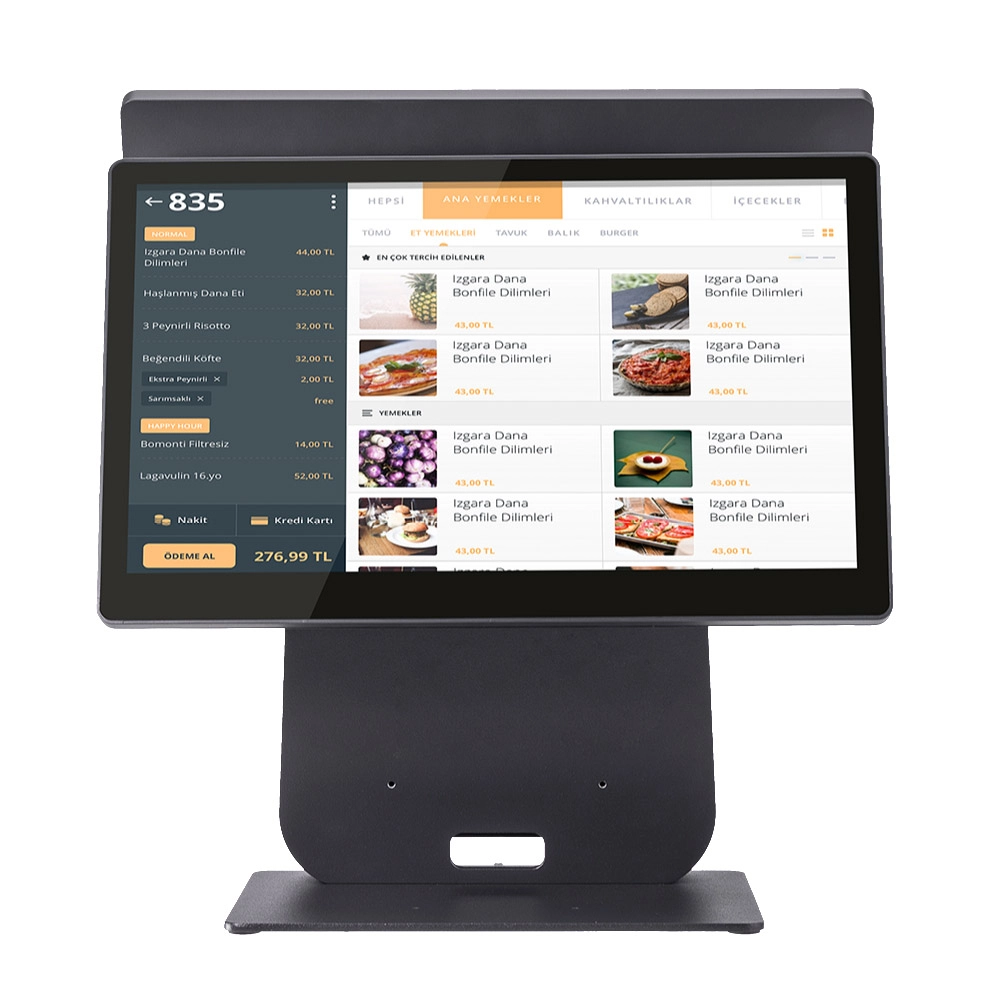
HD Dual Screen POS Machine Aluminum Hardware Android Windows Supplier
This dual-screen POS machine supports both Android and Windows systems, providing flexibility for various applications. The dual screens enhance customer interaction and streamline the checkout process, making transactions quicker and more engaging. Perfect for modern businesses looking to elevate their service and improve customer satisfaction, this POS machine is your ultimate partner in success!

Wall Mount Cash Register POS 21.5 inch for Supermarket Touchscreen Windows Factory
Our sleek and modern wall-mounted POS system features a stunning 21.5-inch LED display, providing exceptional visibility and clarity for seamless customer interactions. The capacitive touchscreen ensures a highly responsive and intuitive user experience, perfect for fast-paced retail environments. With its space-saving wall-mounted design, this POS solution is ideal for optimizing floor space while maintaining a professional and contemporary appearance.


Copyright © 2025 Favorpos All Rights Reserved.
