
POS Terminal vs Cash Register: Key Differences for Buyers
- Navigating the Modern Retail Landscape: Why Technology Choices Matter
- The Evolution of Transaction Processing
- Impact on Business Operations
- POS Terminal vs. Cash Register: A Fundamental Divide
- Defining the Cash Register
- Understanding the POS Terminal
- Beyond Basic Transactions: The Core Differences
- Key Differentiators: Features, Functionality, and Future-Proofing
- Operational Efficiency and Data Insights
- Scalability, Security, and Customer Experience
- Cost Implications and Return on Investment (ROI)
- Making the Right Choice for Your Business: A Strategic Perspective
- Assessing Your Business Needs
- The FAVORPOS Advantage: Modern Solutions for Modern Businesses
- Frequently Asked Questions (FAQ)
- Q1: Can a traditional cash register track inventory?
- Q2: Is a POS terminal difficult to use for employees?
- Q3: What's the average cost difference between a cash register and a POS system?
- Q4: Do I need a POS system for a very small business or a mobile business?
- Q5: How do POS systems enhance customer experience?
- Q6: Are cloud-based POS systems more secure than traditional ones?
- Ready to Elevate Your Business Operations?
As a seasoned professional deeply immersed in the world of retail technology and business operations, I've witnessed firsthand the dramatic evolution of how businesses manage transactions and customer interactions. From the clunky, mechanical cash registers of yesteryear to the sophisticated, cloud-connected point-of-sale (POS) terminals of today, the landscape has transformed. For many business owners, especially those just starting out or looking to upgrade, the distinction between a 'POS terminal' and a 'cash register' can be a source of confusion. It's not just about processing payments; it's about the very backbone of your business's efficiency, data intelligence, and growth potential.
My goal with this article is to cut through that confusion. Drawing on my extensive experience in SEO, , and as a POS system consultant, I'll guide you through the critical differences, helping you understand which system truly aligns with your operational needs, market trends, and customer expectations. We'll explore not just what these systems do, but what they enable your business to achieve, ensuring you make a decision that's not just functional, but strategic.
Navigating the Modern Retail Landscape: Why Technology Choices Matter
In an increasingly competitive market, the technology you choose for your sales operations is no longer just a utility; it's a strategic asset. The right system can streamline workflows, provide invaluable insights, and enhance the customer experience, while the wrong one can hinder growth and create unnecessary bottlenecks. Understanding the core functionalities and capabilities of your transaction processing tools is paramount for any business aiming for long-term success.
The Evolution of Transaction Processing
The journey from simple abacuses to advanced digital systems reflects humanity's continuous quest for efficiency and accuracy in commerce. Early cash registers, patented by James Ritty in 1879, were mechanical marvels designed primarily to prevent employee theft and record sales totals. They were revolutionary for their time, bringing a new level of accountability to retail. Fast forward to the late 20th and early 21st centuries, and the advent of computers and the internet completely reshaped this landscape. The concept of a 'point of sale' expanded beyond a simple cash drawer to encompass an entire ecosystem of hardware, software, and services designed to manage every aspect of a transaction and beyond. This evolution underscores a critical shift: from merely recording sales to actively managing and optimizing business operations.
Impact on Business Operations
The choice between a basic electronic cash register and a sophisticated POS terminal profoundly impacts every facet of your business. A traditional cash register, while capable of handling basic sales and calculating change, offers limited operational advantages beyond that. It's a standalone device, largely disconnected from other business functions. In contrast, a modern POS system acts as a central hub for your entire operation. It integrates sales data with inventory management, customer relationship management (CRM), employee scheduling, and even accounting software. This integration means less manual data entry, fewer errors, and a holistic view of your business performance. The ripple effect of this choice touches everything from inventory accuracy and staffing efficiency to customer satisfaction and strategic decision-making.
POS Terminal vs. Cash Register: A Fundamental Divide
At their core, both a POS terminal and a cash register facilitate sales transactions. However, their underlying architecture, capabilities, and strategic value diverge significantly. Understanding these fundamental differences is the first step toward making an informed decision for your business.
Defining the Cash Register
A cash register, often referred to as an Electronic Cash Register (ECR), is primarily a standalone machine designed for recording sales and processing cash and basic card payments. It typically consists of a keypad for inputting prices, a cash drawer, a receipt printer, and a small display. Some more advanced ECRs might offer basic departmental sales tracking and limited reporting features. They are generally simple to operate, require minimal setup, and are often a cost-effective solution for very small businesses with straightforward needs. However, their functionality is largely confined to the immediate transaction, offering little in the way of advanced data management or integration with other business systems. For a deeper historical context, you can refer to the Wikipedia page on Cash Registers.
Understanding the POS Terminal
A POS terminal, or Point of Sale system, is a much more comprehensive solution. It's not just a piece of hardware but an integrated system comprising hardware (like a touchscreen monitor, barcode scanner, receipt printer, and cash drawer) and sophisticated software. Modern POS systems are often cloud-based, allowing for remote access and real-time data synchronization. They are designed to manage not only sales transactions but also inventory, customer data, employee performance, and detailed sales analytics. A POS terminal acts as the central nervous system for retail and hospitality businesses, providing a wealth of data and automation capabilities that go far beyond simple cash handling. The flexibility and scalability of a POS system make it suitable for a wide range of business sizes and types, from small boutiques to large supermarket chains.
Beyond Basic Transactions: The Core Differences
The most significant distinction lies in their scope. A cash register is a transaction recorder; a POS terminal is a business management tool. This difference manifests in several key areas:
| Feature | Traditional Cash Register (ECR) | Modern POS Terminal (POS System) |
|---|---|---|
| Primary Function | Records sales, calculates change, stores cash. | Records sales, manages inventory, tracks customers, processes various payments, generates reports, manages employees. |
| Connectivity | Standalone, limited or no network connectivity. | Networked (LAN, Wi-Fi), often cloud-based, integrates with other systems. |
| Inventory Management | Manual tracking, no real-time updates. | Automated, real-time inventory tracking, low-stock alerts, purchase order generation. |
| Customer Management | None or very basic customer loyalty features. | Detailed customer profiles, purchase history, loyalty programs, targeted marketing. |
| Reporting & Analytics | Basic sales totals, limited departmental reports. | Comprehensive sales reports (by item, employee, time), profit margins, trend analysis, customizable dashboards. |
| Payment Processing | Cash, basic credit/debit card processing (often requires separate terminal). | Cash, credit/debit cards, mobile payments (Apple Pay, Google Pay), gift cards, contactless payments, split payments. |
| Scalability | Limited to no scalability. Adding more features is difficult or impossible. | Highly scalable, easy to add more terminals, locations, or integrations as business grows. |
| Employee Management | Basic clock-in/out. | Time tracking, sales performance, commission tracking, access permissions. |
| Hardware & Software | Integrated, fixed hardware and firmware. | Modular hardware, flexible software (often subscription-based), regular updates. |
| Security | Physical security of cash drawer, limited data security. | PCI compliance, encryption, user access controls, cloud data backup. |
| Cost | Lower initial upfront cost. | Higher initial investment (hardware + software), often includes recurring software fees. |
Key Differentiators: Features, Functionality, and Future-Proofing
Beyond the fundamental definitions, the practical implications of choosing between a POS terminal and a cash register become evident when we look at their advanced features, operational functionality, and how well they prepare a business for future growth and market changes.
Operational Efficiency and Data Insights
One of the most compelling arguments for a POS system is its ability to dramatically boost operational efficiency. Imagine a retail environment where every sale automatically updates your inventory levels in real-time. This eliminates the need for manual stock counts, reduces instances of overstocking or stockouts, and frees up valuable employee time. A POS terminal can also manage returns, exchanges, and gift card balances seamlessly, providing a consistent and professional customer experience. Furthermore, the data generated by a POS system is a goldmine for business intelligence. You can track sales trends by product, time of day, or employee, identify your most profitable items, understand peak hours, and even analyze customer purchasing patterns. This level of insight is virtually impossible with a traditional cash register, which typically only provides aggregate sales totals. According to a report by the National Retail Federation, data analytics and personalized customer experiences are key drivers for retail innovation, both of which are heavily supported by advanced POS systems.
Scalability, Security, and Customer Experience
As businesses grow, their needs evolve. A traditional cash register offers very little in terms of scalability. If you open a second location, you essentially need a completely separate system with no shared data. A modern POS system, especially a cloud-based one, is built for scalability. You can easily add new terminals, integrate new locations, and expand functionalities as your business expands, all while maintaining a centralized database. Security is another critical differentiator. While cash registers offer physical security for cash, they provide minimal data security. POS systems, on the other hand, are designed with robust security features, including PCI compliance for payment processing, data encryption, user access controls, and regular software updates to guard against cyber threats. This protects both your business and your customers' sensitive information. From a customer experience perspective, a POS terminal offers speed, accuracy, and the flexibility to accept diverse payment methods, including contactless and mobile payments, which are increasingly preferred by consumers. It can also power loyalty programs and personalized promotions, fostering stronger customer relationships.
Cost Implications and Return on Investment (ROI)
The initial cost difference between a cash register and a POS terminal can be significant. A basic electronic cash register might cost a few hundred dollars, while a complete POS system, including hardware and software subscriptions, could range from a few thousand dollars upfront and recurring monthly fees. However, focusing solely on the initial outlay misses the bigger picture of return on investment (ROI). The efficiencies gained from automated inventory, reduced errors, faster transaction times, and invaluable data insights can quickly offset the higher initial investment of a POS system. For instance, by optimizing inventory, a business can reduce waste and improve cash flow. By understanding sales trends, they can make better purchasing decisions. The ability to manage employees, track performance, and even integrate with accounting software further contributes to long-term savings and increased profitability. In essence, a cash register is an expense, while a POS system is an investment in your business's future growth and operational excellence.
Making the Right Choice for Your Business: A Strategic Perspective
Choosing between a POS terminal and a cash register isn't just a technical decision; it's a strategic one that will shape your business's trajectory. It requires a clear understanding of your current operations, your growth ambitions, and the value you place on efficiency and data.
Assessing Your Business Needs
Before making a decision, I always advise clients to conduct a thorough assessment of their specific business needs. Consider the following:
- Business Size and Type: A very small business with minimal inventory (e.g., a lemonade stand or a seasonal pop-up) might suffice with a basic cash register. However, any business with multiple products, employees, or aspirations for growth will quickly outgrow an ECR.
- Transaction Volume: High transaction volumes benefit immensely from the speed and accuracy of a POS system.
- Inventory Complexity: Do you need to track hundreds or thousands of SKUs? Do you deal with variations (size, color)? A POS system is essential for this.
- Payment Methods: Do your customers expect to pay with mobile wallets, gift cards, or split payments?
- Reporting Requirements: Do you need detailed insights into sales, profits, and employee performance?
- Future Growth: Do you plan to expand, open new locations, or introduce e-commerce?
- Budget: While important, remember to consider long-term ROI, not just upfront cost.
For example, a small coffee shop might initially think a cash register is enough. But if they want to track popular drinks, manage loyalty programs, or integrate with an online ordering system, a POS system becomes indispensable.
The FAVORPOS Advantage: Modern Solutions for Modern Businesses
As a trusted company in the POS system industry, FAVORPOS is a company that provides and develops advanced point of sale (POS) systems and solutions for businesses that are committed to using high-tech devices to drive success. My experience with various systems has shown me that the right partner makes all the difference, and FAVORPOS stands out with its dedication to quality and innovation.
Our current solutions include a comprehensive range of POS systems and peripherals, ensuring that businesses of all sizes and market segments—from retail and catering to supermarkets—can find exactly what they need. We understand that every business is unique, which is why we offer OEM and ODM services to fully meet customer needs and optimize their business operations. This commitment to customization and flexibility is a key differentiator, allowing us to deliver solutions that truly fit, rather than generic one-size-fits-all products.
FAVORPOS is not just about selling hardware; it's about providing a complete ecosystem for business success. Our product lineup includes essential tools like Handheld POS terminals for mobile operations, robust POS systems for fixed counters, precise Price Checkers, efficient Thermal Printers for receipts, and secure Cash Drawers. We believe in empowering businesses with technology that enhances efficiency and competitiveness. Our long-term commitment to quality and industry development means that when you choose FAVORPOS, you're investing in a partner that stays ahead of market trends, continuously innovating to meet the evolving demands of modern commerce.
With an outstanding dedication to quality and customers, FAVORPOS always strives to find the best solutions to support all businesses and improve their efficiency in this highly competitive field. Our vision is clear: to become the world's best manufacturer of Point of Sale (POS) systems and solutions. This ambition drives our technical strength, our focus on reliable hardware, and our development of intuitive, powerful software. We don't just provide products; we provide peace of mind and a pathway to sustained growth.
Frequently Asked Questions (FAQ)
Q1: Can a traditional cash register track inventory?
A1: Generally, no. Traditional cash registers (ECRs) have very limited or no inventory tracking capabilities. They primarily record sales totals. Any inventory management would need to be done manually or through a separate, unconnected system. Modern POS terminals, however, offer robust, real-time inventory management features.
Q2: Is a POS terminal difficult to use for employees?
A2: Modern POS terminals are typically designed with user-friendly interfaces, often featuring touchscreens and intuitive software, making them generally easy for employees to learn and operate with minimal training. While there might be a slight learning curve compared to a very basic cash register, the benefits in efficiency and functionality far outweigh this.
Q3: What's the average cost difference between a cash register and a POS system?
A3: The initial upfront cost of a basic electronic cash register can range from $100 to $500. A complete POS system, including hardware (terminal, printer, scanner, cash drawer) and software, can have an initial investment ranging from $1,000 to $5,000 or more, plus recurring monthly software subscription fees (typically $50-$200+ per month). However, the total cost of ownership and ROI often favor POS systems due to their long-term benefits.
Q4: Do I need a POS system for a very small business or a mobile business?
A4: For very small businesses with extremely simple needs and low transaction volume, a basic cash register might suffice. However, even small businesses and mobile operations can greatly benefit from modern POS systems, especially with the availability of compact, mobile, and handheld POS solutions. These offer advanced features like inventory tracking, detailed reporting, and diverse payment acceptance, which are crucial for growth and efficiency regardless of size.
Q5: How do POS systems enhance customer experience?
A5: POS systems enhance customer experience in several ways: faster checkout times, ability to accept various payment methods (including contactless), accurate pricing, seamless returns/exchanges, and personalized loyalty programs or promotions based on purchase history. This creates a more professional, efficient, and tailored shopping experience.
Q6: Are cloud-based POS systems more secure than traditional ones?
A6: Cloud-based POS systems often offer enhanced security features compared to traditional, on-premise systems. They benefit from professional data centers with robust physical and digital security, regular backups, encryption, and automatic software updates to patch vulnerabilities. However, it's crucial to choose a reputable provider that adheres to industry security standards like PCI compliance.
Ready to Elevate Your Business Operations?
The choice between a POS terminal and a cash register is clear for businesses looking to thrive in the modern era. While a cash register serves its basic purpose, a POS system is a strategic investment that empowers your business with efficiency, insights, and a superior customer experience. If you're ready to move beyond basic transactions and embrace a solution that supports your growth, enhances your operational intelligence, and future-proofs your business, it's time to consider a modern POS system.
At FAVORPOS, we are dedicated to providing cutting-edge POS solutions tailored to your unique needs. Explore our range of advanced POS systems, handheld terminals, thermal printers, and other peripherals designed to optimize your business. Contact us today for a consultation or visit our website to view our products and discover how FAVORPOS can help you achieve your business goals.
Everything You Need to Know About barcode scanner machine
How to Choose Right smart pos terminal manufacturer and supplier in Asia?
Best professional receipt printer manufacturers manufacturers and supplier brands in Germany
Custom pos systems for sale Manufacturers and Suppliers
For Distributor
Can I distribute your products in multiple regions?
Yes, we support resellers who wish to operate in multiple regions. We will work with you to understand the regional market requirements and provide the necessary support to ensure successful operations.
For Healthcare
Can the POS system manage multiple locations?
Yes, our system supports multi-location management, allowing for centralized management of multiple facilities or departments.
Can the POS system be integrated with our existing EHR/EMR system?
Absolutely. Our POS solution is able to integrate with multiple electronic health record (EHR) and electronic medical record (EMR) systems to streamline operational processes.
For Grocery and Supermarkets
Can your POS system be integrated with weighing equipment?
Yes, our POS system can be integrated with weighing equipment to facilitate the management of goods sold by weight, such as fresh produce or bulk goods.
For company
How much does customization cost?
The cost varies according to customization requirements. We will provide a detailed quotation after understanding your specific needs.

11.6 inch Capacitive Touchscreen for POS Machine POS Monitor
FAVORPOS 11.6-inch capacitive touchscreen, specifically designed for POS machines to deliver a seamless and responsive user experience. This high-definition display offers vibrant visuals and crystal clear clarity, making it easy for staff to navigate through transactions efficiently. The capacitive technology ensures quick and accurate touch recognition, reducing wait times and enhancing customer satisfaction. Built to withstand the rigors of daily use, this touchscreen is perfect for retail and hospitality environments.
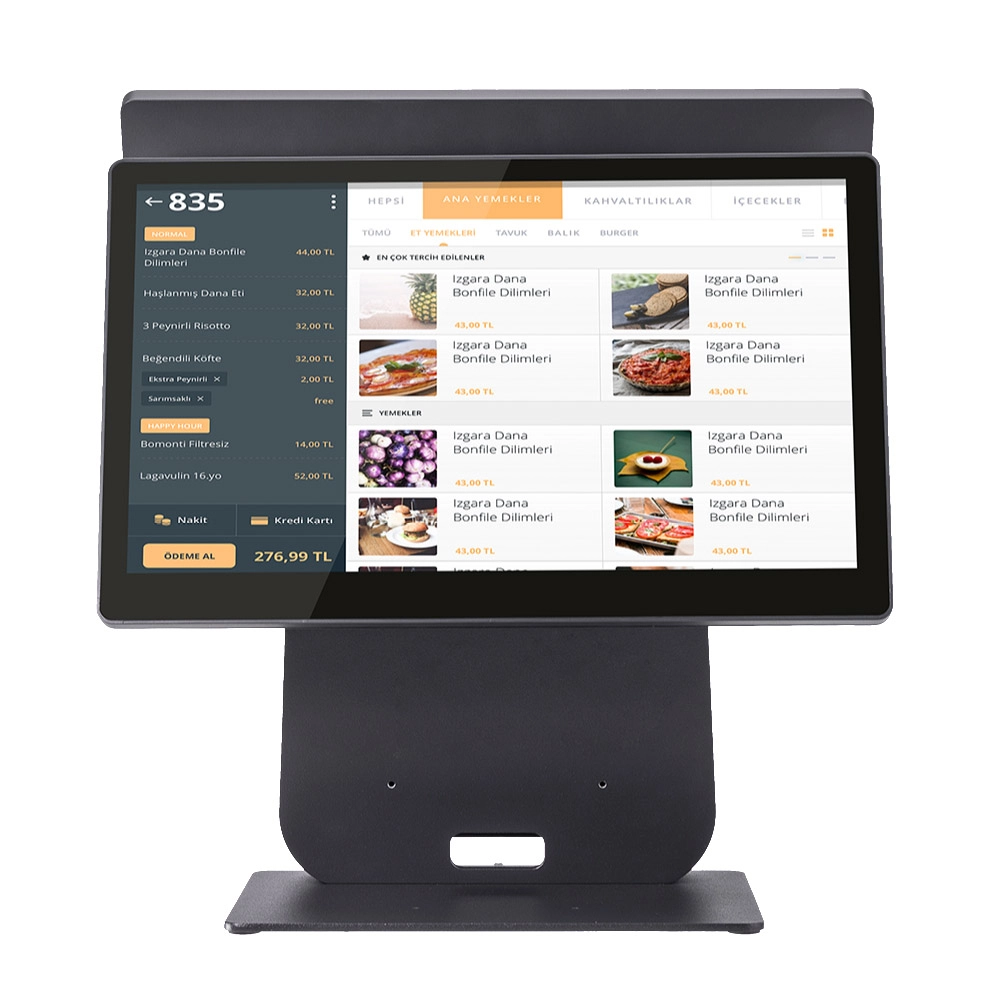
HD Dual Screen POS Machine Aluminum Hardware Android Windows Supplier
This dual-screen POS machine supports both Android and Windows systems, providing flexibility for various applications. The dual screens enhance customer interaction and streamline the checkout process, making transactions quicker and more engaging. Perfect for modern businesses looking to elevate their service and improve customer satisfaction, this POS machine is your ultimate partner in success!
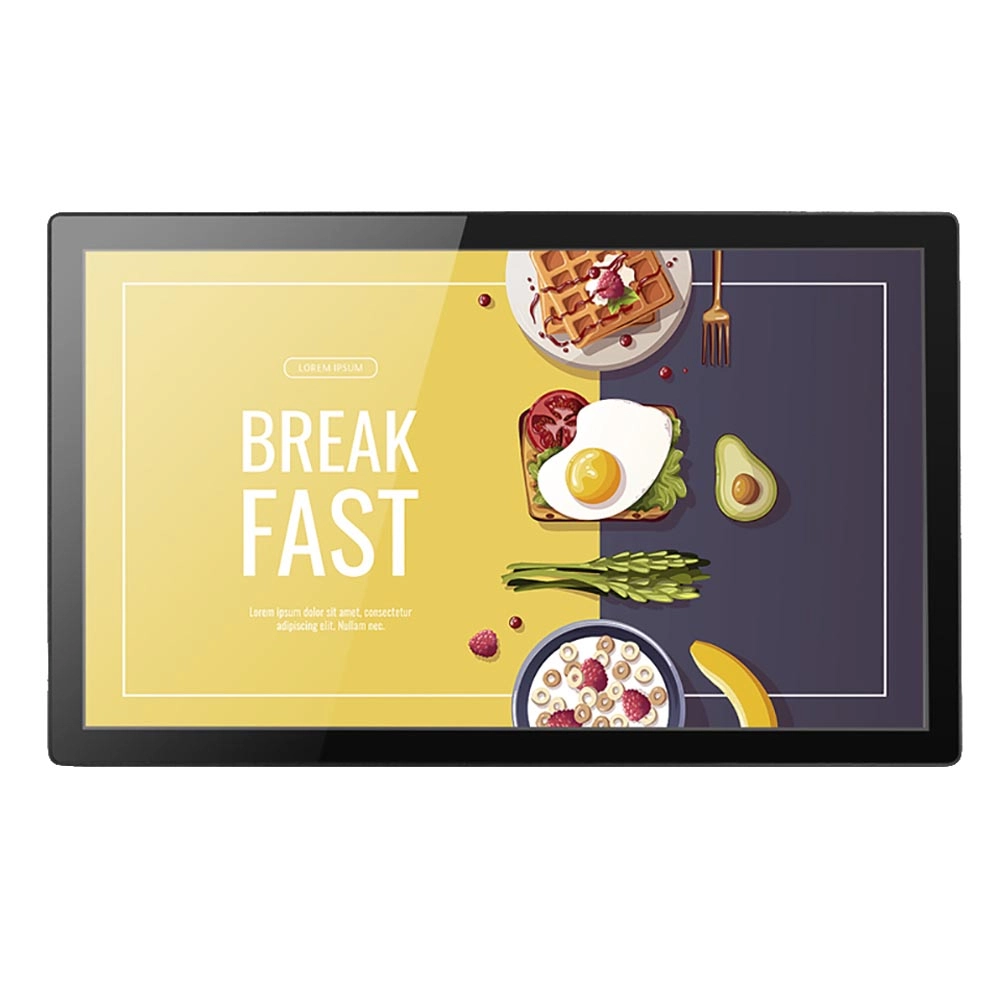
Wall Mount Cash Register POS 21.5 inch for Supermarket Touchscreen Windows Factory
Our sleek and modern wall-mounted POS system features a stunning 21.5-inch LED display, providing exceptional visibility and clarity for seamless customer interactions. The capacitive touchscreen ensures a highly responsive and intuitive user experience, perfect for fast-paced retail environments. With its space-saving wall-mounted design, this POS solution is ideal for optimizing floor space while maintaining a professional and contemporary appearance.
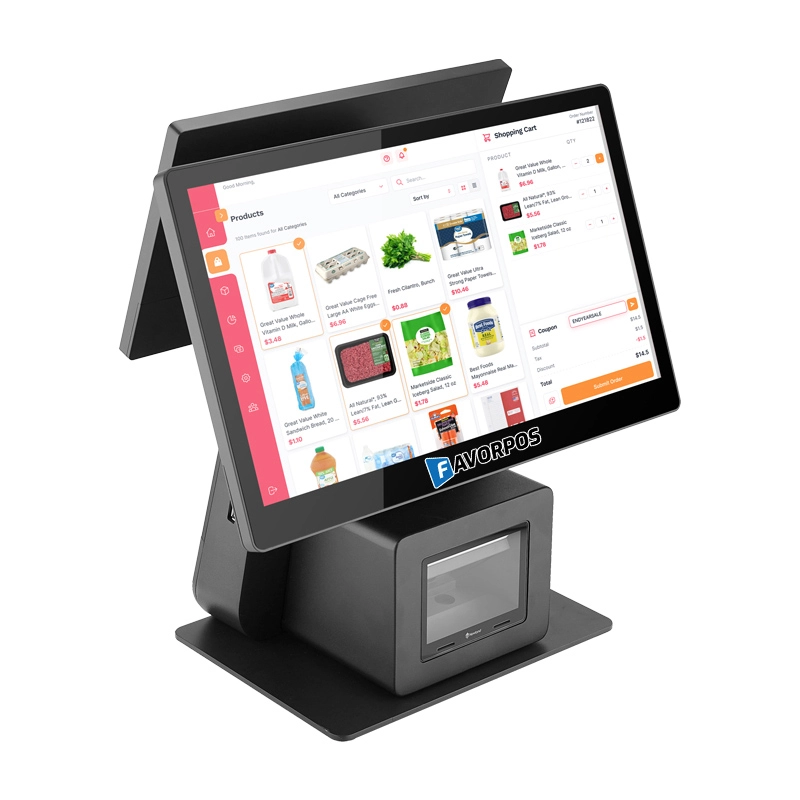
Dual Screen POS With Barcode Scanner Desktop POS Manufacturer POS Factory 15.6 11.6 Client Screen Optional
FAVORPOS: Your leading dual screen POS factory and manufacturer. Our desktop POS with barcode scanner offers 15.6/11.6 client screen options and OS flexibility. Get reliable, efficient dual screen POS with barcode scanner solutions directly from us.


Copyright © 2025 Favorpos All Rights Reserved.
