
Top Restaurant POS Systems 2026: Best Options Compared
- The Pivotal Role of Your Restaurant's POS System in a Digital Age
- Beyond Transactions: A Strategic Asset for Growth
- Adapting to Evolving Customer Expectations
- Operational Efficiency and Data-Driven Decisions
- Defining the Top Restaurant POS Systems of 2026
- Cloud-Based Flexibility and Scalability
- Integrated Payment Processing and Security
- Advanced Inventory and Menu Management
- Robust Reporting and Analytics
- Seamless Third-Party Integrations
- Comparing Leading Solutions: A Strategic Approach for Your Restaurant
- Key Comparison Criteria for 2026
- Assessing Your Unique Restaurant Needs
- The Importance of a Trusted Partner: Embracing Innovation with FAVORPOS
- Frequently Asked Questions (FAQ) About Restaurant POS Systems
- 1. What is the main difference between cloud-based and on-premise POS systems for restaurants?
- 2. How much does a restaurant POS system typically cost?
- 3. Can a restaurant POS system integrate with my existing accounting and online ordering software?
- 4. How do POS systems help with inventory management and reducing waste?
- 5. What security measures should I look for in a restaurant POS system?
- 6. Are handheld POS devices suitable for all types of restaurants?
In the dynamic world of hospitality, staying ahead means embracing innovation. As we look towards 2026, the humble Point of Sale (POS) system has evolved far beyond a simple cash register. It's now the central nervous system of any successful restaurant, dictating efficiency, guest satisfaction, and ly, profitability. My extensive experience in the POS and landscape, coupled with a deep understanding of market trends and user pain points, has given me a unique vantage point to assess what truly makes a POS system 'top-tier' in today's, and tomorrow's, competitive environment. This guide will walk you through the essential considerations and best options to ensure your restaurant thrives.
Choosing the best restaurant POS system in 2026 isn't just about processing transactions; it's about future-proofing your business. From cloud-based systems offering unparalleled flexibility to integrated solutions that streamline every aspect of your operations, the choices are vast. The semantic keywords surrounding 'top restaurant POS systems' often include 'best restaurant management software,' 'cloud POS for restaurants,' 'restaurant payment processing,' 'inventory management systems for food service,' and 'contactless ordering solutions.' My goal is to provide a resource that not only answers these queries but offers actionable insights, leveraging current industry standards and predicting future needs. Let's delve into what makes a POS system truly exceptional for your culinary venture.
The Pivotal Role of Your Restaurant's POS System in a Digital Age
In today's fast-paced restaurant industry, a POS system is no longer a mere operational tool; it's a strategic asset that underpins every aspect of your business. The demands on restaurants have escalated, from managing online orders and diverse payment methods to optimizing labor costs and personalizing customer experiences. My years in this field have shown me that the right POS system doesn't just keep up with these demands; it empowers businesses to anticipate and exceed them.
Beyond Transactions: A Strategic Asset for Growth
Gone are the days when a POS system simply rang up sales. Today's top restaurant POS systems are robust platforms offering comprehensive restaurant management features. They integrate front-of-house (FOH) operations like order taking and payment processing with back-of-house (BOH) functions such as inventory management, recipe costing, and staff scheduling. For instance, according to a report by the National Restaurant Association, technology adoption is critical for restaurant success, with POS systems being foundational to digital transformation efforts. National Restaurant Association.
This integration provides a holistic view of your operations, enabling data-driven decisions that can significantly impact your bottom line. I've witnessed countless businesses leverage detailed sales reports from their POS to identify peak hours, popular menu items, and even staff performance, leading to optimized resource allocation and increased revenue.
Adapting to Evolving Customer Expectations
Customers today expect seamless experiences, from effortless online ordering to diverse payment options, including mobile and contactless payments. A modern restaurant POS system facilitates this by offering features like QR code ordering, integrated online ordering platforms, and loyalty programs. My insight suggests that systems that prioritize customer convenience and offer personalized interactions will be the most sought-after in 2026. For example, a customer's preference stored in the POS can lead to tailored recommendations, enhancing their dining experience and fostering loyalty.
Operational Efficiency and Data-Driven Decisions
The efficiency gains from an advanced POS system are immense. From reducing order errors through digital Kitchen Display Systems (KDS) to automating inventory reorders, these systems minimize manual tasks and free up staff to focus on customer service. Moreover, the rich data generated by these systems offers invaluable insights. I often advise clients to look beyond just sales data. Analyze labor costs against sales, identify waste in inventory, and track customer feedback integrated directly into the POS. This granular data empowers managers to make swift, informed decisions, reducing operational bottlenecks and maximizing profitability.
Defining the Top Restaurant POS Systems of 2026
When I evaluate the best POS systems for restaurants, I look for a blend of innovation, reliability, and adaptability. The market is saturated, but a few core features consistently stand out as essential for high-performing systems. These aren't just 'nice-to-haves'; they are critical components that differentiate a good system from a truly great one.
Cloud-Based Flexibility and Scalability
The shift to cloud-based POS systems is irreversible and will be dominant by 2026. Cloud POS offers unparalleled flexibility, allowing owners and managers to access real-time data from anywhere, on any device. This means managing inventory from home, checking sales reports while traveling, or adjusting menu prices instantly across multiple locations. More importantly, cloud systems are inherently scalable, easily accommodating business growth, seasonal fluctuations, or even new locations without major hardware investments. This flexibility is a game-changer for multi-location enterprises and burgeoning startups alike, as confirmed by industry reports indicating a strong preference for cloud solutions due to their lower upfront costs and easier maintenance. Wikipedia - Cloud POS.
Integrated Payment Processing and Security
A top-tier restaurant POS system must offer seamless, secure payment processing. This includes support for EMV chip cards, NFC contactless payments (like Apple Pay and Google Pay), and mobile payment options. Crucially, these systems must adhere to PCI DSS compliance standards to protect sensitive customer data. I always emphasize the importance of integrated payment solutions that prevent manual errors and streamline end-of-day reconciliation. The fewer third-party tools you need to juggle, the smoother your operations will be.
Advanced Inventory and Menu Management
For any restaurant, controlling costs starts with inventory. The best restaurant POS systems for 2026 will feature sophisticated inventory management tools that track ingredients from delivery to plate, manage recipes, calculate food costs, and even automate purchase orders when stock runs low. This level of control reduces waste, prevents stockouts, and ly improves profit margins. Furthermore, intuitive menu management allows for quick updates, specials, and allergen information, ensuring accuracy and efficiency, especially for businesses with frequently changing menus.
Robust Reporting and Analytics
Data is the new currency. A superior POS system provides customizable, detailed reports on everything from sales performance and labor costs to item profitability and customer trends. These analytical capabilities empower restaurant owners to identify opportunities, troubleshoot issues, and make informed strategic decisions. I always look for systems that offer real-time reporting dashboards, enabling immediate insights rather than waiting for end-of-day summaries.
Seamless Third-Party Integrations
No single system can do it all perfectly. The ability of a POS to integrate seamlessly with other essential restaurant technologies is paramount. This includes accounting software (like QuickBooks or Xero), online ordering platforms, reservation systems, loyalty programs, and employee scheduling tools. The more integrations a system supports, the more cohesive and efficient your overall technology ecosystem will be, minimizing data silos and manual data entry.
Comparing Leading Solutions: A Strategic Approach for Your Restaurant
With numerous options available, comparing top restaurant POS systems can feel overwhelming. My approach is to focus on core functionalities relative to your specific business needs. Here's a framework to guide your evaluation:
Key Comparison Criteria for 2026
When assessing various systems, I recommend a structured approach. Think about how each system performs against these critical criteria:
| Feature/Criterion | Description & Why It Matters | Ideal Performance |
|---|---|---|
| Ease of Use & Training | How intuitive is the interface for new staff? Minimizes training time and errors. | Graphical, touch-friendly interface; quick onboarding for diverse staff. |
| Hardware Flexibility | Can it run on various devices (tablets, handhelds, traditional terminals)? Adapts to FOH & BOH needs. | Supports multiple form factors (iPad, Android tablets, specialized POS terminals, handheld POS). |
| Offline Mode Capability | Can it function if the internet goes down? Prevents business disruption. | Full functionality (order taking, payment processing) during internet outages. |
| Customer Support | Availability and quality of technical support. Crucial for resolving urgent issues. | 24/7 support via multiple channels (phone, chat, email), quick resolution times. |
| Total Cost of Ownership (TCO) | Includes hardware, software subscriptions, payment processing fees, installation, and training. Comprehensive financial planning. | Transparent pricing, no hidden fees, scalable subscription tiers. |
| Customization Options | Can it be tailored to your unique menu, workflow, and branding? Supports specific operational needs. | Customizable menus, order flows, loyalty programs, and user permissions. |
| Reporting & Analytics Depth | Detailed insights into sales, labor, inventory, and customer behavior. Drives strategic decisions. | Real-time dashboards, customizable reports, predictive analytics. |
Assessing Your Unique Restaurant Needs
Before diving into specific brands, map out your restaurant's unique requirements. Are you a fine-dining establishment needing robust reservation and table management? A bustling quick-service restaurant (QSR) prioritizing speed and integrated online ordering? Or a multi-location chain requiring centralized management? The best 'top restaurant POS systems' are those that perfectly align with your operational model and growth ambitions. Consider your average transaction volume, the complexity of your menu, your labor structure, and your future expansion plans. This self-assessment is the bedrock of a smart POS decision.
The Importance of a Trusted Partner: Embracing Innovation with FAVORPOS
As an expert immersed in the intricacies of POS technology and its application, I've observed that true success often hinges on partnering with a provider that not only offers cutting-edge products but also understands the evolving needs of the industry. This is where companies like FAVORPOS excel, demonstrating a clear commitment to quality and technological advancement.
FAVORPOS is a company that provides and develops advanced point of sale (POS) systems and solutions for businesses committed to using high-tech devices to drive success. Our current solutions include POS systems and peripherals, cash registers, handheld terminals and scanners, price checkers, thermal printers, and accessories for different market segments such as retail, catering, supermarkets, etc. My assessment of the market indicates that businesses are increasingly seeking integrated solutions that are robust, reliable, and adaptable – precisely what FAVORPOS is designed to deliver.
As a trusted company in the POS system industry, FAVORPOS provides OEM and ODM services to fully meet customer needs and optimize their business operations. We have a long-term commitment to quality and industry development. This capability to offer Original Equipment Manufacturing (OEM) and Original Design Manufacturing (ODM) services is a significant differentiator. It means that whether you require a bespoke solution tailored to highly specific operational demands or a branded product with your unique stamp, FAVORPOS possesses the technical prowess and flexibility to deliver. This level of customization and support is crucial for businesses looking to gain a competitive edge in a saturated market, reflecting a deep understanding of diverse user pain points.
With an outstanding dedication to quality and customers, FAVORPOS always strives to find the best solutions to support all businesses and improve their efficiency in this highly competitive field. Our vision is to become the world's best manufacturer of Point of Sale (POS) systems and solutions. This dedication is evident in their product range, which covers crucial components of a modern restaurant's POS ecosystem: from reliable Handheld POS devices that empower staff to take orders tableside and process payments on the go, to robust POS systems that form the core of your restaurant's operations. Their offerings also extend to essential peripherals like Price Checkers for retail integrations, high-performance Thermal Printers for receipts and kitchen tickets, and secure Cash Drawers. These products are engineered to work synergistically, providing a seamless and efficient operational flow.
FAVORPOS’s strength lies not just in manufacturing, but in developing solutions that anticipate industry trends, ensuring that their clients are equipped with future-proof technology. Their commitment to R&D ensures that their products incorporate the latest advancements in connectivity, security, and user experience, which is paramount for businesses aiming to adopt the top restaurant POS systems of 2026. For more information, visit www.favorpos.com.
Frequently Asked Questions (FAQ) About Restaurant POS Systems
1. What is the main difference between cloud-based and on-premise POS systems for restaurants?
Cloud-based POS systems store your data on remote servers accessible via the internet, offering flexibility, remote access, lower upfront costs, and automatic updates. On-premise (or traditional) POS systems store data on local servers within your restaurant, requiring higher upfront investment for hardware and IT maintenance, but offering greater control over your data and less reliance on internet connectivity.
2. How much does a restaurant POS system typically cost?
The cost varies significantly. Cloud-based systems often have a monthly or annual subscription fee (ranging from $50 to $200+ per terminal), plus hardware costs (which can be a few hundred to a couple of thousand dollars per station). On-premise systems have a higher upfront cost for software licenses and hardware (potentially thousands of dollars per station), plus ongoing maintenance and support fees. Payment processing fees are usually separate and vary by provider and transaction volume.
3. Can a restaurant POS system integrate with my existing accounting and online ordering software?
Yes, most modern, top restaurant POS systems offer robust integration capabilities. They can typically connect with popular accounting software (like QuickBooks, Xero), online ordering platforms (e.g., DoorDash, Uber Eats, custom websites), reservation systems, and payroll software. Always verify specific integrations before committing to a system to ensure compatibility with your existing tech stack.
4. How do POS systems help with inventory management and reducing waste?
Advanced POS systems include features to track ingredient usage in real-time as items are sold. They can manage recipes, calculate food costs per dish, set par levels, and even automate reorder alerts or generate purchase orders when stock runs low. This helps prevent over-ordering, minimizes spoilage, and provides accurate cost-of-goods-sold data, directly contributing to waste reduction and improved profitability.
5. What security measures should I look for in a restaurant POS system?
Prioritize systems that are PCI DSS compliant for payment processing, encrypt sensitive data (both in transit and at rest), offer robust user access controls (role-based permissions), and provide secure remote access. Cloud-based systems should have strong data backup and disaster recovery protocols. Two-factor authentication for administrative access is also a highly recommended security feature.
6. Are handheld POS devices suitable for all types of restaurants?
Handheld POS devices are incredibly versatile. They are particularly beneficial for full-service restaurants to take tableside orders and process payments, speeding up service and improving accuracy. For quick-service or food truck operations, they enhance mobility and customer throughput. While not essential for every restaurant, they offer significant efficiency and customer experience benefits, especially as part of a larger, integrated POS ecosystem.
Choosing the right restaurant POS system is a foundational decision for your business's future. By prioritizing features that enhance efficiency, improve customer experience, and provide actionable insights, you can select a system that not only meets the demands of 2026 but positions your restaurant for sustained success. Consider your specific operational needs, evaluate total cost of ownership, and seek out a partner committed to innovation and quality, much like FAVORPOS with its comprehensive range of advanced POS solutions. For personalized consultation on optimizing your restaurant's operations or to explore our high-tech POS devices, please don't hesitate to contact us or visit our product pages today.
Tips for Wholesale pos machine price in France
Custom oem thermal printer Manufacturers and Suppliers in France
Wholesale pos for windows manufacturer and supplier
Wholesale pos for android manufacturer and supplier
For OEM
Can the POS machine be customized with multiple functions?
Yes, we provide a wide range of functional customization options, including hardware configuration, software functions, brand design, etc. You can choose different processors, screens, connection options, payment modules, etc. according to your business needs.
Do you provide technical support and training services?
Yes, we provide comprehensive online technical support and training services to help your team become familiar with the operation and maintenance of POS machines.
For Restaurants & Cafes
How to update the menu or add new items?
After being equipped with the corresponding software, our POS machine allows you to easily update the menu through the backend management interface. You can add new items, modify prices or adjust the menu layout, and all changes will be reflected in the system in real time, ensuring that employees always have the latest menu information.
For E-commerce
Can I manage multiple online stores from one system?
Yes, our POS system supports multi-location and multi-store management, allowing you to centrally manage all e-commerce operations.
For Distributor
What are the benefits of joining your reseller network?
Benefits include access to innovative POS products, attractive margins, comprehensive training and support, and the opportunity to work with a globally recognized brand.

11.6 inch Capacitive Touchscreen for POS Machine POS Monitor
FAVORPOS 11.6-inch capacitive touchscreen, specifically designed for POS machines to deliver a seamless and responsive user experience. This high-definition display offers vibrant visuals and crystal clear clarity, making it easy for staff to navigate through transactions efficiently. The capacitive technology ensures quick and accurate touch recognition, reducing wait times and enhancing customer satisfaction. Built to withstand the rigors of daily use, this touchscreen is perfect for retail and hospitality environments.
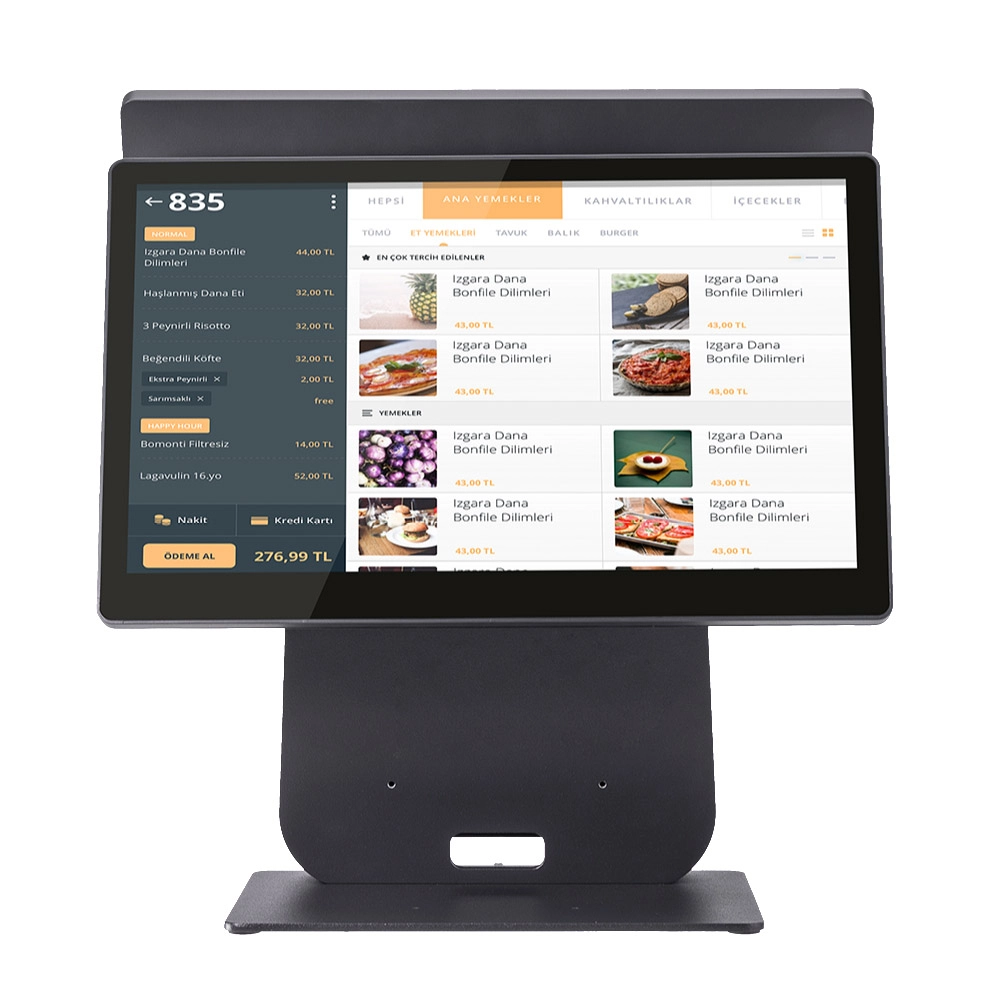
HD Dual Screen POS Machine Aluminum Hardware Android Windows Supplier
This dual-screen POS machine supports both Android and Windows systems, providing flexibility for various applications. The dual screens enhance customer interaction and streamline the checkout process, making transactions quicker and more engaging. Perfect for modern businesses looking to elevate their service and improve customer satisfaction, this POS machine is your ultimate partner in success!
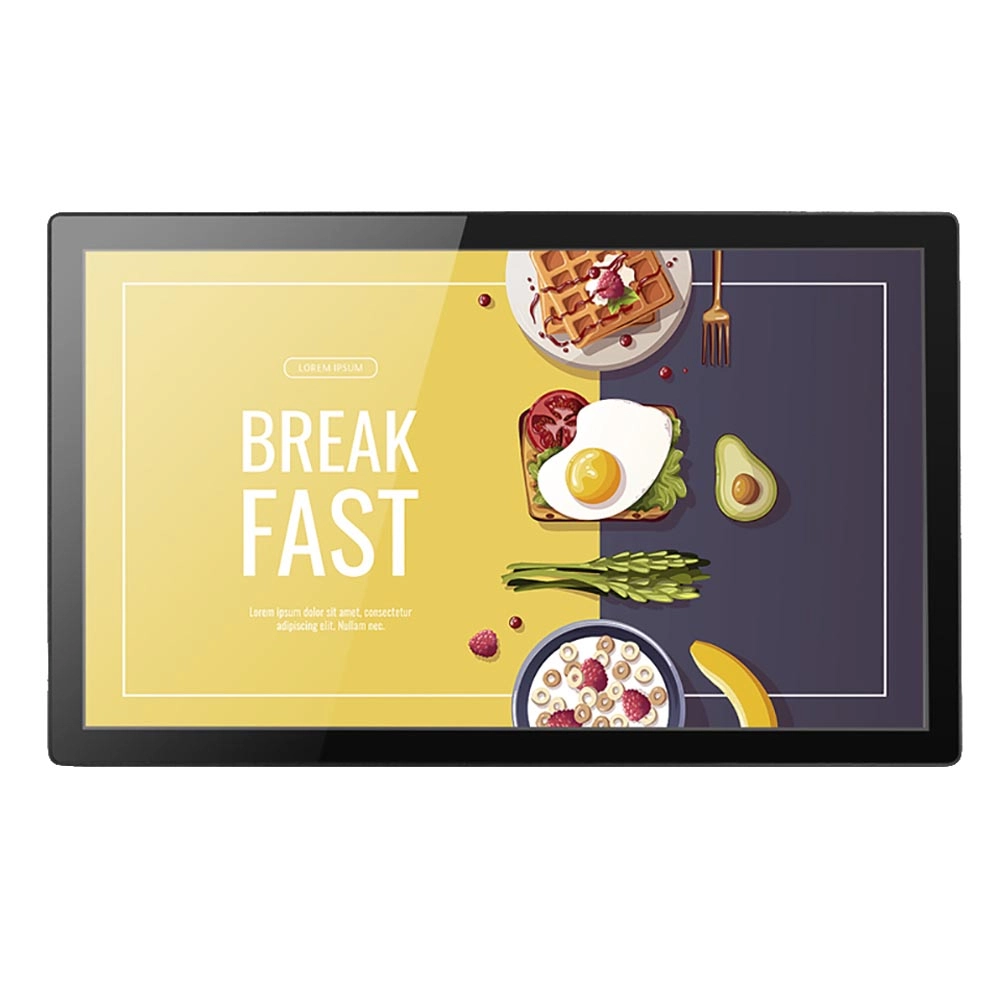
Wall Mount Cash Register POS 21.5 inch for Supermarket Touchscreen Windows Factory
Our sleek and modern wall-mounted POS system features a stunning 21.5-inch LED display, providing exceptional visibility and clarity for seamless customer interactions. The capacitive touchscreen ensures a highly responsive and intuitive user experience, perfect for fast-paced retail environments. With its space-saving wall-mounted design, this POS solution is ideal for optimizing floor space while maintaining a professional and contemporary appearance.
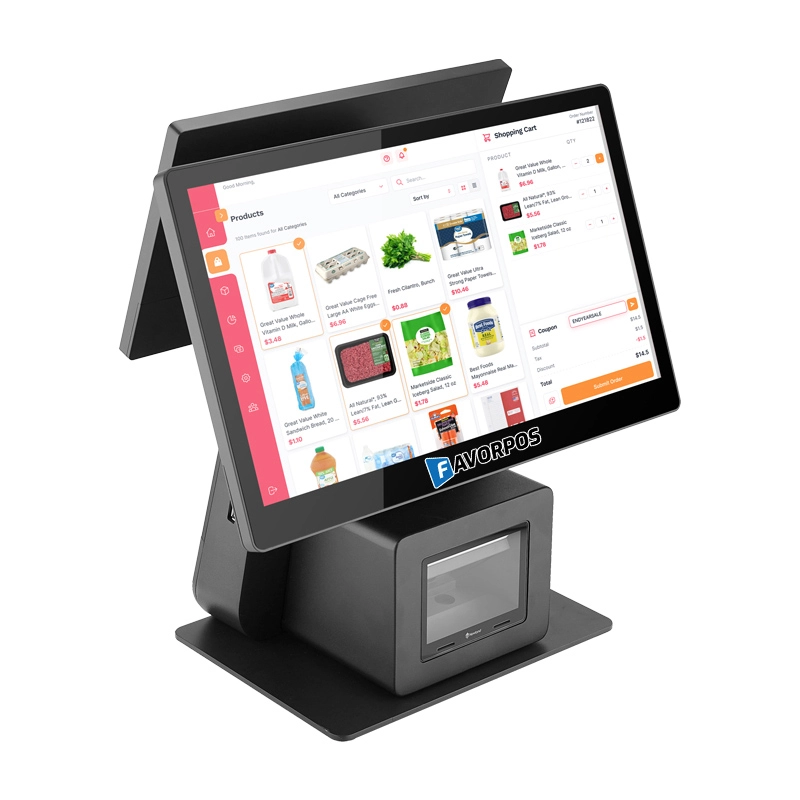
Dual Screen POS With Barcode Scanner Desktop POS Manufacturer POS Factory 15.6 11.6 Client Screen Optional
FAVORPOS: Your leading dual screen POS factory and manufacturer. Our desktop POS with barcode scanner offers 15.6/11.6 client screen options and OS flexibility. Get reliable, efficient dual screen POS with barcode scanner solutions directly from us.


Copyright © 2025 Favorpos All Rights Reserved.
